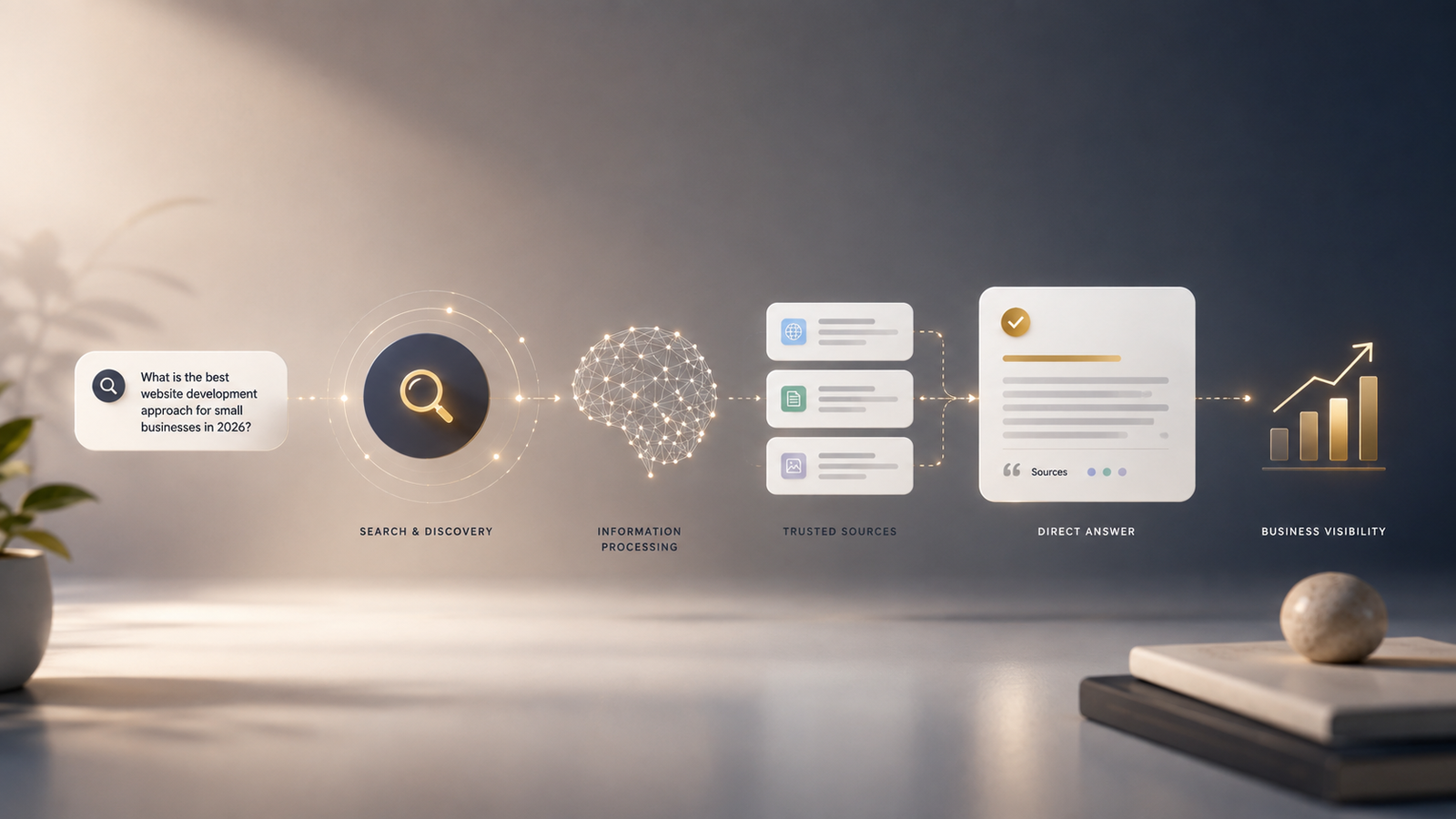
The way people search for information online is changing.
For years, businesses primarily focused on ranking their websites in traditional search engine results. Search engine optimisation, commonly known as SEO, became one of the most important ways for businesses to attract people who were actively looking for products, services, answers and information.
Today, search is becoming more conversational and answer-focused.
People can search through traditional search engines, AI-powered search experiences, conversational assistants, answer engines, voice interfaces and other emerging discovery platforms.
Instead of simply receiving a list of webpages, users can increasingly receive direct answers, summaries, recommendations, comparisons and sources.
This evolution has created growing interest in Answer Engine Optimization, or AEO.
But what exactly is AEO?
How is it different from SEO?
And what can businesses do today to prepare their websites for the changing search landscape?
Let's explore it.
What Is Answer Engine Optimization?
Answer Engine Optimization, or AEO, is the practice of creating and structuring content so that search engines, answer engines and AI-powered systems can better understand the information and potentially use it when responding to relevant user questions.
Traditional SEO focuses heavily on helping webpages become discoverable and visible in search results.
AEO places greater emphasis on providing clear, useful and well-structured answers to the questions people are asking.
For example, someone searching for a web design company may ask:
"What should a small business website include?"
A traditional search experience may return a list of webpages.
An answer-focused search experience may provide a direct summary of important elements and potentially reference information from several sources.
AEO is about making your website a clear, useful and trustworthy source of information that can be understood within these evolving search experiences.
Why Is AEO Becoming Important in 2026?
Search behaviour is becoming more conversational.
People are increasingly comfortable asking detailed questions rather than relying only on short keyword searches.
For example, a traditional search might be:
"website design cost"
A conversational query could be:
"How much does it cost to build a professional website for a small business?"
The second query provides significantly more context.
Modern search systems are increasingly designed to understand the meaning behind these longer questions and provide more direct answers.
This creates a new opportunity for businesses.
Instead of only asking:
"How can I rank my website?"
businesses should also think about:
"Does my website provide the clearest and most useful answer to the questions my potential customers are asking?"
That is where AEO becomes relevant.
AEO vs SEO: What's the Difference?
AEO and SEO are closely related, but they have different areas of emphasis.
SEO focuses on improving the visibility and discoverability of webpages in search engines.
AEO focuses more heavily on making information clear, structured and useful for systems that provide direct answers.
A simple way to think about it is:
SEO:
Help people discover your website through search.
AEO:
Help make the information on your website understandable and useful when search systems generate answers.
However, AEO should not be treated as a replacement for SEO.
The two approaches overlap in many important areas.
A technically accessible website, useful content, strong authority, good user experience, relevant information and clear website structure can support both traditional search and answer-focused experiences.
Why Businesses Should Pay Attention to AEO
The customer journey is becoming more complex.
Someone researching a business may discover it through:
• Traditional search results • AI-powered search • Conversational assistants • Voice search • Social platforms • Online communities • Business directories • Maps and local discovery • Video platforms • Recommendation systems
This means businesses need to think about visibility across the broader search ecosystem.
Your website should not only exist.
It should clearly communicate:
What your business does
Who you help
What products or services you offer
What problems you solve
Why customers should trust you
How your products or services work
How customers can contact you
The clearer this information is, the easier it is for users and digital systems to understand your business.
Create Content That Answers Real Questions
One of the strongest foundations of AEO is answering questions that your customers actually ask.
Every business has questions that potential customers ask before making a decision.
For a web design company, these could include:
How much does a website cost?
How long does it take to build a website?
What should a business website include?
Does a small business need a website?
How can I improve my website conversion rate?
What is responsive web design?
How does SEO help a business?
What is the difference between SEO and AEO?
What makes a website trustworthy?
What should I look for when choosing a web development company?
These questions can become valuable content opportunities.
Instead of creating articles simply because a keyword has search volume, create content because it solves a genuine problem for your audience.
That approach can help your website become more useful to both people and modern search systems.
Give Direct Answers
If a visitor asks a question, make the answer easy to find.
Avoid hiding the main answer underneath several paragraphs of introduction.
For example, if the heading is:
What Is AEO?
Start with a clear definition.
Answer Engine Optimization is the practice of creating and structuring online content so search engines, answer engines and AI-powered systems can better understand and potentially use that information when responding to relevant questions.
Then provide additional explanation.
This creates a better experience for visitors because they can quickly understand the answer before deciding whether they want to read more.
Use Clear Content Structure
Content structure is extremely important for both users and search systems.
Avoid creating large walls of text.
Instead, organise your information using:
• Clear headings • Subheadings • Short paragraphs • Bullet points • Numbered lists • Tables where appropriate • Definitions • Examples • FAQs
For example, an article about website costs could use sections such as:
How Much Does a Website Cost?
What Affects Website Pricing?
How Much Does E-commerce Development Cost?
What Is Included in Website Development?
How Can You Reduce Website Costs?
Frequently Asked Questions
This structure makes the information easier to navigate and understand.
Write Naturally and Clearly
AEO does not mean writing content that sounds robotic.
The content should be written for humans first.
Use simple and natural language.
Avoid unnecessary jargon.
Explain technical concepts when they are important.
Use examples whenever they make the subject easier to understand.
The objective is not to make a page look like it was created specifically for an algorithm.
The objective is to provide the best possible answer to the reader's question.
Understand Search Intent
Search intent refers to the reason behind a search.
Someone searching:
"best website design company"
has a different intention from someone searching:
"what is responsive web design?"
The first person may be comparing providers.
The second person is probably looking for information.
Other common search intentions include:
Informational
The user wants to learn something.
Commercial
The user is researching options before making a purchase.
Transactional
The user is ready to take action.
Navigational
The user is looking for a specific website or business.
Understanding search intent helps you create content that actually matches what users want.
Build Topic Authority
A single article rarely demonstrates complete expertise around a subject.
Instead, businesses can create connected groups of useful content.
For example, a digital agency could create a content cluster around modern search:
What Is Answer Engine Optimization?
AEO vs SEO: What's the Difference?
How Does AI-Powered Search Work?
How to Optimise a Website for Modern Search
How to Create Content That Answers Customer Questions
What Is Generative Engine Optimization?
How Can Businesses Improve Online Visibility?
Each article can link naturally to related articles.
This creates a useful information network for visitors and helps search engines understand the relationship between different topics on your website.
Use Internal Linking
Internal links connect one page on your website to another.
For example, an article about AEO could link to a related article about:
SEO
Website design
Website speed
Content marketing
Conversion optimisation
Digital marketing
Internal linking helps visitors discover additional information without leaving your website.
It also helps search engines discover and understand relationships between your pages.
What Is Answer Engine Optimization (AEO)? The 2026 Guide for Businesses
Keep Business Information Consistent
Businesses should make their important information clear and consistent.
This includes:
• Business name • Services • Contact information • Website address • Business description • Areas served • Industry expertise • Products or solutions
Make sure important information is not contradictory across your website and legitimate business profiles.
Clear and consistent information makes it easier for customers and search systems to understand who you are and what your business provides.
Strengthen Your Website's Trust Signals
AEO is not simply about answering questions.
Trust matters too.
When people research a business, they want evidence that the company is legitimate and capable.
Useful trust signals can include:
• Customer reviews • Testimonials • Case studies • Portfolio examples • Client results • Author information • Business details • Certifications • Awards • Industry experience • Clear contact information
Whenever possible, support claims with evidence.
Instead of saying:
"We are experts in web development."
show examples of your work.
Instead of saying:
"Our customers love our service."
show genuine customer reviews.
Real evidence is more useful than empty marketing claims.
Create Original and Useful Content
There is already a huge amount of generic information online.
Publishing another article that repeats the same basic points may not give users much value.
Try to bring something original to the conversation.
This could include:
• Your own experience • Original research • Case studies • Data • Real examples • Expert analysis • Screenshots • Comparisons • Step-by-step processes • Lessons from real projects
For example, a web development company could explain how a specific website redesign improved user experience or increased enquiries.
Original information can make content more useful and demonstrate genuine experience.
Keep Content Accurate and Updated
Search behaviour changes.
Technology changes.
Products change.
Businesses change.
Information that was accurate a year ago may no longer be accurate today.
Review important content regularly.
Check:
• Statistics • Product information • Pricing • Links • Screenshots • Industry claims • Examples • Technology references
Update content when necessary.
Don't change content simply to make it look fresh.
Make meaningful updates when the information has actually changed or can be improved.
Use Structured Data Where Appropriate
Structured data provides additional information about the content of a webpage in a format that search engines can understand.
Depending on the page, structured data may be relevant for:
• Articles • Products • Organisations • Services • Events • Reviews • Frequently asked questions
Structured data should accurately represent the visible information on the page.
It should not be used to manipulate search results or make claims that are not supported by the actual content.
Don't Ignore Technical SEO
AEO does not remove the need for technical SEO.
Your website should still be:
• Accessible to search engines • Mobile-friendly • Fast • Secure • Easy to navigate • Properly structured • Free from major technical issues
Important technical areas include:
Page performance
Mobile usability
Indexability
Internal linking
Page titles
Meta descriptions
Canonical URLs
XML sitemaps
Image optimisation
Clean website architecture
Technical problems can prevent valuable content from being discovered or understood properly.
Focus on User Experience
A website should be easy to use.
Visitors should be able to quickly understand:
Where they are
What the page is about
What the business offers
Where to find additional information
How to contact the business
What they should do next
Good user experience includes:
• Clear navigation • Readable typography • Logical layouts • Accessible content • Fast page loading • Mobile responsiveness • Clear calls to action • Easy-to-use forms
AEO should support a better user experience, not replace it.
Think About Conversational Search
People often phrase questions differently when speaking compared with typing.
Someone might type:
"web design cost"
But ask a conversational search system:
"How much should I expect to pay for a professional website for my business?"
The second query contains more context.
Businesses should therefore understand how their customers naturally describe their problems.
Talk to customers.
Review sales conversations.
Look at support questions.
Analyse website enquiries.
Review search suggestions.
Identify frequently asked questions.
Then create content that addresses those questions.
Make Important Information Easy to Find
Don't hide important information deep inside your website.
If you provide a service, explain it clearly.
If customers frequently ask about pricing, explain the factors that influence pricing.
If customers ask about your process, create a dedicated process section or page.
If customers want to know whether you work with their type of business, make that information clear.
Your website should reduce uncertainty.
The easier it is to find useful information, the easier it becomes for visitors to make informed decisions.
AEO and AI-Generated Content
AI tools can help businesses research, outline and draft content.
However, publishing large amounts of generic AI-generated content without human review is not a strong content strategy.
AI-assisted content should still be:
• Fact-checked • Edited • Relevant • Original • Useful • Written for the intended audience • Reviewed by someone with appropriate knowledge
The value of content comes from its usefulness and accuracy, not simply from how quickly it was produced.
Businesses should use technology to improve their content workflow rather than replacing expertise and judgement.
How to Start AEO for Your Business
You don't need to change your entire website immediately.
Start with a practical process.
Step 1: Identify customer questions.
Write down the questions your customers ask before buying.
Step 2: Review existing pages.
Look for pages where answers are incomplete, unclear or outdated.
Step 3: Improve your answers.
Make information more direct, useful and specific.
Step 4: Create supporting content.
Build articles, guides and FAQs around relevant customer questions.
Step 5: Improve your website structure.
Use logical navigation, headings and internal links.
Step 6: Add trust signals.
Include genuine reviews, case studies, portfolio examples and relevant business information.
Step 7: Check technical foundations.
Make sure search engines can access and understand your website.
Step 8: Keep information updated.
Review important content regularly.
Step 9: Measure performance.
Track organic traffic, engagement, enquiries, conversions and other relevant business outcomes.
Common AEO Mistakes to Avoid
AEO is a developing area and there is no guaranteed formula for appearing in every answer engine or AI-powered search experience.
Avoid:
• Keyword stuffing • Writing unnaturally • Publishing low-quality AI-generated content • Creating hundreds of pages with little value • Copying competitors • Making unsupported claims • Using irrelevant structured data • Publishing outdated information • Ignoring technical SEO • Focusing entirely on algorithms instead of users
Don't try to manipulate search systems.
Build content that genuinely deserves to be discovered and referenced.
AEO Checklist for Businesses
Use this checklist to review your website:
• Do we answer common customer questions?
• Are our answers clear and direct?
• Is our content easy to scan?
• Do our pages use logical headings?
• Does each important service have a dedicated page?
• Is our business information consistent?
• Do we have useful internal links?
• Is the website mobile-friendly?
• Does the website load quickly?
• Is the content original and useful?
• Do we demonstrate genuine expertise?
• Do we provide evidence such as reviews or case studies?
• Is important information kept up to date?
• Are technical SEO fundamentals in place?
• Do we understand what our customers are actually searching for?
If the answer is yes to most of these questions, your website has a strong foundation for modern search visibility.
What Does AEO Mean for Small Businesses?
AEO is not only relevant to large companies.
Small businesses can benefit from becoming a useful source of information within a specific niche.
For example, a professional service provider could create detailed resources explaining:
How much does the service cost?
How long does the process take?
What does the service include?
What should customers prepare?
What questions should customers ask before hiring a provider?
What mistakes should customers avoid?
What results can customers realistically expect?
This type of content helps potential customers make better decisions.
The goal isn't to publish more content.
The goal is to publish better answers.
The Future of Search
Search is becoming more diverse.
Traditional search engines remain important, but users can now discover information through many different interfaces and platforms.
These include:
• Traditional search results • AI-powered search experiences • Conversational assistants • Voice interfaces • Social platforms • Video platforms • Online communities • Maps and local search • Business directories • Recommendation systems
Businesses therefore need to think beyond a single search results page.
The long-term opportunity is to build a strong digital presence that clearly communicates what your business does, demonstrates expertise and provides useful information wherever potential customers are looking.
AEO is one part of that broader strategy.
Final Thoughts
Answer Engine Optimization is becoming an increasingly relevant part of the modern search landscape.
But AEO should not be viewed as a replacement for SEO.
The strongest approach is to build a website that works well for people while also providing information that modern search systems can understand.
Create useful content.
Answer real questions.
Use clear structures.
Build genuine authority.
Provide evidence.
Keep information accurate.
Maintain strong technical foundations.
Make your website easy to use.
And most importantly, focus on helping your audience.
There is no guaranteed trick that will make a business appear in every AI-generated answer or search experience.
Instead, the sustainable approach is to become a reliable and useful source of information within your industry.
When your website clearly explains what you do, answers the questions your customers have and demonstrates why your business can be trusted, you create a stronger foundation for both traditional search and the evolving world of answer-focused discovery.
At My Digital Creations, we believe modern websites should be designed for more than just visibility.
They should provide useful information, create a great user experience, build trust and help businesses achieve real goals.
If you're looking to improve your website's SEO, user experience, content strategy or overall online visibility, My Digital Creations can help you build a stronger digital presence for the modern search landscape.
Want Help With This?
Let's talk about how this applies to your business.