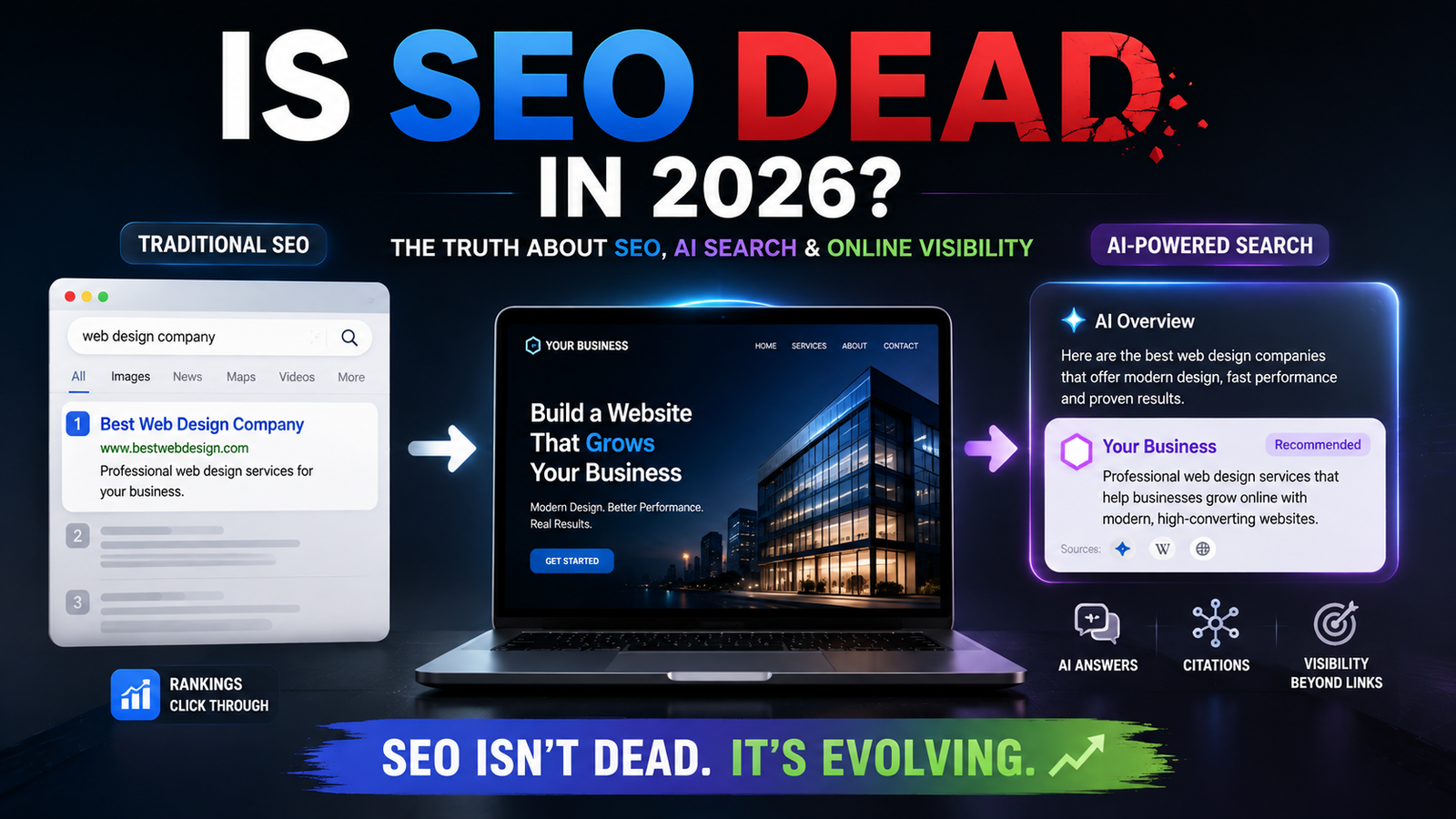
If you have been following digital marketing in 2026, you have probably seen the same question everywhere:
Is SEO dead?
The short answer is no.
But SEO is changing.
For years, businesses focused heavily on ranking their websites in traditional search results. The goal was straightforward: find the right keywords, create useful content, build authority, optimize technical SEO and earn a position near the top of the search results.
Today, the search experience is becoming much more sophisticated.
People can increasingly ask complex questions and receive AI-generated summaries, conversational answers and recommendations without following the traditional path of searching through multiple websites.
Google has expanded AI-powered search experiences, while AI answer engines and conversational search tools are changing how people discover information online.
That does not mean businesses should abandon SEO.
It means businesses need to understand what modern search looks like and build a visibility strategy that works across traditional search and AI-powered discovery.
What Is SEO?
SEO, or Search Engine Optimisation, is the process of improving a website so that search engines can understand, trust and potentially rank its content for relevant searches.
Traditional SEO includes areas such as:
• Keyword research • Helpful and relevant content • Technical SEO • Website structure • Page speed and usability • Internal linking • Backlinks and authority • Mobile optimisation • Search intent • Structured data • Website accessibility
The objective is not simply to place keywords on a page.
Modern SEO is about helping search systems understand what your business offers and why your website is a useful and trustworthy result for a particular search.
So, Is SEO Actually Dead?
No.
What is changing is the way people search and how search engines present information.
The traditional search journey often looked like this:
User searches → Search results → Clicks a website → Reads information → Takes action
Modern search can look more like:
User asks a question → AI or search system processes information → Direct answer or summary → Sources and recommendations → User decides what to explore next
This changes the visibility game.
A business may now need to be visible not only as a traditional search result but also as a trusted source that can be discovered, referenced or recommended within AI-powered search experiences.
SEO Is Evolving, Not Disappearing
The biggest mistake businesses can make in 2026 is treating traditional SEO and AI search optimisation as completely separate worlds.
They overlap heavily.
Google's own 2026 guidance around generative AI features makes an important point: the same fundamental SEO practices remain relevant for AI-powered search experiences.
That means businesses should not throw away everything they have learned about SEO just because AI search is growing.
Instead, they should strengthen the fundamentals.
Create useful content.
Make the website easy to crawl.
Build authority.
Provide accurate information.
Understand user intent.
Keep important information accessible.
And make the website genuinely useful.
Traditional SEO is still the foundation.
But the surface where visibility happens is expanding.
From Ten Blue Links to Answers
For a long time, search engines were primarily viewed as directories of websites.
A user searched for something.
The search engine returned a list of results.
The user clicked a result and continued their research on the website.
AI-powered search introduces another layer.
Instead of simply showing a list of pages, search systems can process information and generate a response to a user's question.
This creates a major change for businesses.
Your website is no longer only competing to be clicked.
It can also compete to become one of the sources that an AI-powered search experience uses when constructing an answer.
That makes authority, accuracy, relevance and content quality increasingly important.
What Are AI Overviews and AI Search?
AI-powered search experiences are designed to help users get answers to more complex questions by combining search technology with generative AI.
Google's AI search products include experiences such as AI Overviews and AI Mode.
Other platforms and answer engines are also changing how people discover information by providing conversational answers, summaries, citations and recommendations.
The exact technology and behavior differs between platforms.
But the broader shift is similar:
Search is becoming more conversational.
Search is becoming more contextual.
And search is increasingly capable of answering questions directly.
This is one reason businesses need to think beyond traditional rankings.
Why Zero-Click Searches Matter
One of the biggest changes in modern search is the growth of searches where users receive enough information directly in the search experience that they do not necessarily click a website.
This is often described as a zero-click search.
A recent 2026 study examining Google searches with AI Overviews found that clicks to cited sources were very rare in its dataset, highlighting how AI-generated answers can change the traditional relationship between search visibility and website traffic.
This creates a new challenge for businesses.
If fewer people click through to websites for certain searches, simply measuring organic traffic may not tell the complete story.
A brand can potentially gain visibility through being mentioned or cited even when the user does not immediately visit the website.
This is why modern SEO needs to consider both traffic and visibility.
SEO vs AEO vs GEO
As AI search has grown, several new terms have become popular.
SEO means Search Engine Optimization.
AEO means Answer Engine Optimization.
GEO commonly means Generative Engine Optimization.
These terms can sound like completely different disciplines, but there is considerable overlap between them.
SEO focuses broadly on search visibility.
AEO focuses on making content useful and accessible for direct-answer experiences.
GEO focuses on visibility within generative AI experiences, including being referenced, cited or mentioned in AI-generated answers.
The terminology is still evolving.
The important thing for businesses is not the label.
The important thing is building a digital presence that search engines and AI-powered systems can understand and trust.
Why Traditional SEO Still Matters
With all the attention around AI search, it can be tempting to think traditional SEO no longer matters.
That would be a mistake.
A strong technical foundation remains important.
Your website still needs to be:
• Crawlable • Fast • Mobile-friendly • Secure • Well structured • Easy to navigate • Accessible to search systems • Built around useful content
Search engines still need to discover and understand your website.
If your website has poor technical foundations, adding AI-focused content will not magically solve the problem.
AI Search Does Not Eliminate Website Quality
Another misconception is that AI search means businesses no longer need good websites.
The opposite can be true.
A strong website remains the foundation of your online presence.
Your website provides:
• Business information • Product and service details • Expertise • Case studies • Reviews and trust signals • Contact information • Original content • Supporting evidence • Brand identity
AI search may change how users discover this information, but businesses still need a reliable source of information for search systems and customers.
Think of your website as the source of truth for your digital presence.
How AI Search Changes Content Strategy
Content strategy is changing as well.
In the past, many SEO strategies focused heavily on individual keywords.
For example:
"web design company"
"website development"
"website design services"
Modern search requires a deeper understanding of why the user is searching.
Instead of only targeting keywords, businesses should build content around real questions, problems and decisions.
For example:
How much does a business website cost?
Should I buy a website or pay monthly?
How long does it take to build a website?
What makes a website convert visitors into customers?
Do I need SEO for my business?
How does AI search affect SEO?
These questions reflect actual user intent.
A website that answers them clearly can become more useful to both customers and search systems.
Create Content That Answers Real Questions
If you want your content to perform well in modern search, start with the questions your customers actually ask.
Think about:
What problems do they have?
What are they comparing?
What are they worried about?
What information do they need before buying?
What mistakes are they trying to avoid?
What would they ask a salesperson?
Then create content that answers those questions directly.
Avoid unnecessary filler.
Avoid repeating the same keyword dozens of times.
Avoid writing articles simply because a keyword has search volume.
Write because the information is genuinely useful.
Build Topical Authority
One article rarely establishes strong authority around an entire subject.
Instead, businesses can create a connected collection of useful content.
For example, a digital agency could publish content around:
Website design
Website conversion
SEO
AEO
AI search
Digital marketing
Website pricing
Website security
Is SEO Dead in 2026? The Truth About SEO, AI Search & Online Visibility
Website maintenance
Business automation
Custom software
These topics can support one another through internal links and consistent expertise.
Over time, this creates a stronger topical presence than publishing unrelated articles every week.
Original Information Matters
AI can generate huge amounts of generic content.
That creates a problem.
If every website publishes the same information, why should a search engine or AI system prefer one source over another?
Original information can help.
Businesses can publish:
• Original research • Case studies • Real project results • Expert opinions • First-hand experiences • Unique data • Comparisons • Detailed examples • Practical frameworks • Industry observations
Instead of simply rewriting information that already exists online, provide something that adds genuine value.
Make Your Website Easy to Understand
Search systems need to understand what your business does.
Make important information clear.
Your website should clearly communicate:
Who you are.
What you offer.
Who you help.
Where you operate.
What problems you solve.
Why customers should trust you.
How people can contact you.
What makes your service different.
Do not make visitors or search systems work unnecessarily hard to figure out what your business actually does.
Use Clear Structure
Good structure benefits both people and machines.
Use:
• Clear headings • Short paragraphs • Descriptive page titles • Logical navigation • Internal links • Lists where appropriate • FAQs • Relevant structured data where applicable
If an article answers a question, make the answer easy to find.
If a service page explains an offering, organise the information logically.
Clarity is one of the simplest ways to improve the usability of your content.
Don't Forget About Brand Authority
Modern search visibility is not only about what your own website says.
Search systems can also encounter your brand across other parts of the web.
That means businesses should think about their broader digital presence.
This can include:
• Industry publications • Business directories • Reviews • Partnerships • Social profiles • Relevant communities • News coverage • Expert mentions • Third-party websites
The objective should not be collecting random mentions.
The objective should be building a genuine reputation around your brand.
AI Search Does Not Mean You Need AI-Generated Everything
Another mistake businesses are making is assuming that because AI is changing search, every piece of content should be generated by AI.
That is not the point.
AI can help with research, brainstorming, organisation and productivity.
But businesses still need:
Human expertise.
Original thinking.
Fact checking.
Real experience.
Useful examples.
Accurate information.
A website filled with generic AI-generated articles does not automatically become authoritative.
Quality still matters.
What Businesses Should Stop Doing in 2026
If your SEO strategy still relies heavily on the following tactics, it may be time to rethink it:
• Keyword stuffing • Publishing low-quality articles in bulk • Writing only for search engines • Copying competitors • Creating pages with little unique value • Buying irrelevant backlinks • Publishing generic AI-generated content without review • Ignoring technical SEO • Ignoring mobile users • Treating SEO as a one-time project
Search is becoming more sophisticated.
Your strategy needs to become more sophisticated too.
What Businesses Should Start Doing
In 2026, businesses should focus on:
1. Building technically strong websites.
2. Creating genuinely useful content.
3. Answering real customer questions.
4. Developing topical authority.
5. Demonstrating expertise and experience.
6. Building a trustworthy brand presence.
7. Optimizing content for both traditional search and AI-powered discovery.
8. Monitoring how customers discover the business.
9. Updating outdated information.
10. Measuring visibility, conversions and business outcomes instead of rankings alone.
SEO Is Becoming More About Visibility Than Rankings
The old question was:
"What position does my website rank at?"
That question is still useful.
But it is no longer the only question.
Businesses should also ask:
Does my brand appear when customers search for relevant problems?
Is my content being discovered?
Is my business being mentioned in relevant answers?
Are customers finding useful information about us?
Are search visitors converting?
Are AI-powered search experiences changing how our customers discover us?
This is a broader definition of online visibility.
What Should Your SEO Strategy Look Like in 2026?
A practical strategy can be divided into five areas.
1. Technical Foundation
Make sure search systems can access and understand your website.
2. Helpful Content
Create content that solves real problems and answers real questions.
3. Authority
Build genuine expertise and trust around your subject.
4. AI Search Visibility
Structure useful information so it can be understood and potentially referenced across modern search experiences.
5. Conversion
Do not forget the final objective.
Visibility is valuable, but businesses ultimately need enquiries, customers, sales or another meaningful outcome.
Getting traffic that never converts is not a successful digital strategy.
A Simple 2026 SEO Checklist
Before you finish your SEO strategy, ask:
□ Is my website technically healthy?
□ Is my website mobile-friendly?
□ Can search engines easily crawl important pages?
□ Does every important page have a clear purpose?
□ Does my content answer real customer questions?
□ Am I creating original and useful information?
□ Is my website easy to understand?
□ Am I building genuine authority?
□ Are my important business details clearly available?
□ Am I monitoring AI-powered search visibility as well as traditional rankings?
□ Am I measuring enquiries and conversions?
If you answered "no" to several of these questions, there may be opportunities to improve your search strategy.
The Future of SEO Is Not About Choosing Between SEO and AI
The biggest mistake would be treating the future as:
SEO vs AI.
It is more accurately:
SEO + AI-powered search.
Traditional search is not simply disappearing overnight.
Instead, search is becoming a broader ecosystem.
People will continue using search engines, but they are also increasingly interacting with conversational interfaces, AI-generated answers and other discovery experiences.
Businesses that adapt early can build a stronger foundation for this changing environment.
Final Verdict: Is SEO Dead in 2026?
No.
SEO is not dead.
The old idea of SEO as simply "getting your website to rank on Google" is becoming too narrow.
Search is changing.
AI-powered answers are changing.
User behavior is changing.
And the way businesses need to think about visibility is changing.
But the fundamentals remain surprisingly consistent.
Be useful.
Be trustworthy.
Be technically accessible.
Answer real questions.
Demonstrate expertise.
Build a strong brand.
Create content worth referencing.
And make your website valuable to the people you want to reach.
The businesses that understand this shift will not abandon SEO.
They will evolve it.
SEO is moving from a simple ranking game toward a broader visibility strategy across search engines, answer engines and AI-powered discovery.
So the better question isn't:
"Is SEO dead?"
It is:
"Is your SEO strategy ready for what search is becoming?"
Want Help With This?
Let's talk about how this applies to your business.