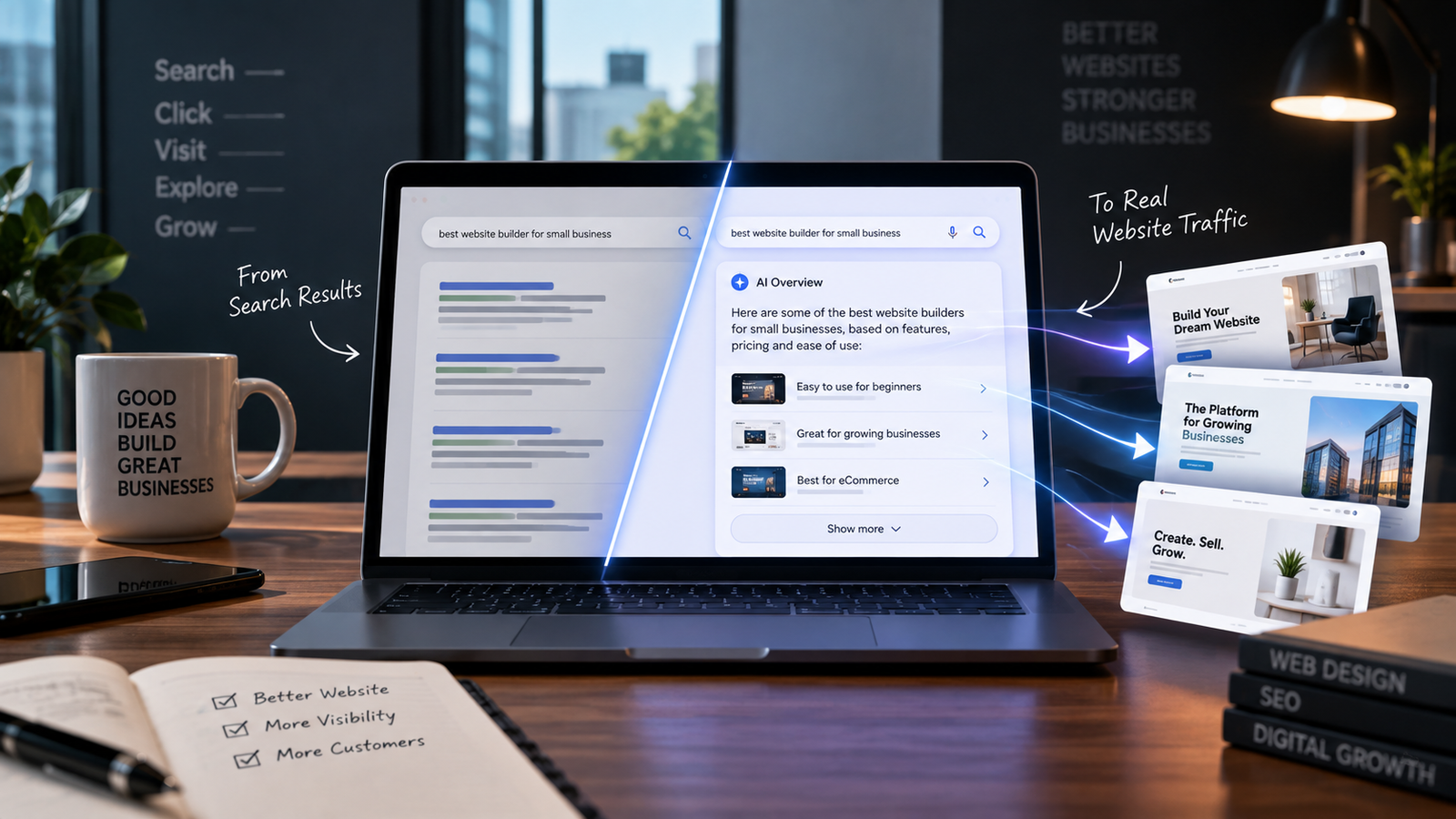
Imagine someone searches for your product on Google.
A few years ago, the journey was simple.
They searched.
They saw a list of websites.
They clicked one.
They read the page.
Maybe they bought something.
In 2026, that journey can look very different.
A person can ask Google a long, conversational question and receive an AI-generated response that brings together information from multiple sources before they even open a website.
That raises a big question for every business with an online presence:
If Google is answering more questions directly, what happens to website traffic?
The answer is more interesting than simply saying "traffic will go down."
Google Search is changing, but websites are not disappearing.
In fact, Google says its AI Search experiences are designed to help people discover websites, and the company has been adding more links and website previews to AI-generated responses. Google also says AI Overviews now have more than 2.5 billion monthly active users, while AI Mode has passed one billion monthly users.
At the same time, publishers and businesses are raising legitimate concerns about how AI-generated answers could change the traditional click-based web. European regulators are even examining Google's proposed controls that would allow websites to opt out of appearing in its AI Search features without affecting their normal Search rankings.
So what is actually happening?
Let's break it down.
What Are Google AI Overviews and AI Mode?
Google's AI-powered Search experiences are designed to help users explore complicated questions more naturally.
Instead of typing several short searches and opening multiple pages, someone can ask a more detailed question and receive an AI-generated response.
For example, instead of searching:
"Best website platform for small business"
someone might ask:
"I run a small consulting company and want a website that is easy to maintain, fast, professional and capable of generating leads. What should I choose?"
The search experience can then help organize information around the question.
AI Overviews and AI Mode are therefore changing not just what people see in Search, but also how people search.
Google says people are asking longer and more complex questions in its AI Search experiences and that its newer Search features include more links, website previews and ways to explore original content.
Does This Mean People Will Stop Visiting Websites?
Not necessarily.
This is where the conversation often becomes misleading.
It is tempting to say:
"Google has AI now, so nobody will click websites anymore."
The reality is more complicated.
Google reported in August 2025 that overall organic click volume from Google Search to websites was relatively stable year over year at that time, while the company said average click quality had increased. Google also noted that users still click through when they want to explore a topic, learn more, read a detailed review or make a purchase.
But that does not mean every website will see the same results.
Search behaviour is changing.
Some searches can be answered quickly inside Search.
Other searches create a desire to investigate further.
And that difference is becoming extremely important for businesses.
The Search Journey Is Changing
Think about two different searches.
The first:
"What is the capital of France?"
The user probably wants a quick answer.
There may be little reason to visit a website.
Now consider:
"Which CRM should a 20-person B2B company choose if it needs automation, sales reporting, integrations and a reasonable total cost?"
That's different.
The user may want comparisons.
Reviews.
Examples.
Pricing.
Real experiences.
Screenshots.
Case studies.
Product demonstrations.
Eventually, they may want to visit a website and make a decision.
This is why businesses should stop thinking only about ranking for keywords.
The bigger goal is becoming a useful source throughout the customer's decision-making journey.
Google Is Giving Website Owners More Visibility Into AI Search
One of the most important developments for website owners happened in 2026.
Google introduced new Search Console reporting for generative AI features.
As of August 31, 2026, these insights were rolled out globally.
The reports can show website owners information such as how often their URLs appeared in generative AI features, which pages appeared, countries where visibility occurred and performance over time.
That's a significant change.
For years, businesses have looked at traditional Search Console metrics such as impressions, clicks, click-through rate and position.
Now website owners have more visibility into how their content appears within Google's generative AI Search experiences.
This means businesses can begin asking a better question:
"Where is my website appearing in AI Search?"
Not just:
"What position am I ranking at?"
Traditional SEO Is Not Dead
This is probably the most important point in this entire article.
AI Search does not mean you should throw away SEO.
Google's own documentation says that existing SEO fundamentals continue to be relevant for appearing in its AI features.
Google recommends following Search Essentials, creating helpful and reliable content, making pages accessible to search engines, and focusing on content that provides real value.
In other words:
The rules are evolving, but the foundation still matters.
Technical SEO still matters.
Good website structure still matters.
Relevant content still matters.
Internal linking still matters.
Page experience still matters.
Crawlability still matters.
And most importantly, the content needs to deserve attention.
But Generic Content Is Becoming a Bigger Problem
This is where many businesses are going to struggle.
Imagine two websites.
Website A publishes:
"10 Benefits of Digital Marketing"
The article contains general statements that could appear on thousands of other websites.
Website B publishes:
"How We Reduced Cost Per Lead for a Local Service Business: What Worked, What Failed and What We Changed"
The second article contains something the internet cannot easily get from another generic page:
experience.
That difference matters.
Google's current guidance for AI Search emphasizes unique, non-commodity content and encourages websites to provide useful information, original perspectives and strong page experiences.
This means the future of SEO is not simply:
"Write more articles."
It is:
"Create something worth finding."
Original Information Is Becoming More Valuable
Think about what AI can easily summarize.
Basic definitions.
Common tips.
Widely repeated statistics.
Generic introductions.
Surface-level explanations.
Now think about what is harder to replace.
A company's actual experience.
A customer case study.
Original research.
A unique comparison.
A detailed experiment.
First-hand observations.
Expert analysis.
Original photographs.
Product testing.
Real examples.
These are the kinds of assets that can give a website a stronger reason to exist.
Google has also said that people increasingly want original content, authentic perspectives and deeper information when exploring topics through Search.
Your Website Still Needs to Be Easy for Machines to Understand
There is another side to this.
Creating great content is not enough if your website is difficult to understand.
Search systems need to be able to discover and interpret your pages.
That means businesses should pay attention to fundamentals such as:
Clear page titles.
Logical headings.
Descriptive URLs.
Internal links.
Accessible content.
Structured information where appropriate.
Search-friendly page architecture.
Fast and usable pages.
Google's Search documentation continues to emphasize making content accessible to search engines and following technical Search Essentials.
The goal is simple:
Make your website easy for both humans and machines to understand.
What About AI-Generated Content?
This is another area where businesses need to be careful.
Using AI to help research, organize ideas or improve content is not automatically a problem.
But publishing huge amounts of low-value AI-generated pages simply to manipulate Search can create problems.
Google's guidance specifically says generative AI can be useful for research and adding structure to original content, but generating many pages without adding value may violate its spam policies.
So the question isn't:
"Was AI used to create this?"
A better question is:
Google AI Search Is Changing Website Traffic: What Businesses Need to Know in 2026
"Does this content actually help the person reading it?"
AI can help with production.
It should not replace responsibility.
SEO Is Becoming More About Visibility Across Search Experiences
Traditional SEO often focused heavily on rankings.
Position 1.
Position 2.
Position 3.
But AI Search introduces another layer.
Your website might be discovered through an AI-generated answer.
A specific page might be referenced.
A brand might be mentioned during a broader research journey.
A user might then search your company directly.
They might visit your website later.
They might watch your video.
They might read your case study.
They might compare your product with another company.
The customer journey can become less linear.
That's why businesses should think about search visibility, not just rankings.
What Should Businesses Do in 2026?
The answer isn't to panic.
It is to adapt.
Here are some practical steps.
1. Build content around real customer questions
Don't just create articles because a keyword has volume.
Find out what your customers actually want to know before buying.
2. Add original insights
Share experience, examples, data, opinions and case studies that cannot easily be copied from another website.
3. Strengthen your website structure
Make your pages easy to navigate and understand.
4. Keep technical SEO healthy
Make sure important pages can be crawled, indexed and accessed properly.
5. Improve page experience
A beautiful website is not enough if it is slow, difficult to use or frustrating on mobile.
6. Build topical authority
Instead of publishing random articles, create useful coverage around the subjects your business actually understands.
7. Don't abandon traditional SEO
Search Essentials and fundamental SEO practices still matter for Google's AI-powered Search experiences.
8. Start measuring AI Search visibility
If you manage a website, check the new generative AI reporting available in Search Console and monitor how your pages are appearing in Google's AI Search features.
9. Build a brand, not just a ranking
When people recognize and trust your company, they are more likely to search for you directly.
10. Give people a reason to click
Don't publish something that an AI summary can completely replace.
Give visitors something deeper.
A better explanation.
A real example.
A useful tool.
A unique opinion.
A case study.
A product demonstration.
Something worth visiting.
The Biggest Mistake Businesses Can Make
The biggest mistake isn't ignoring AI.
It is reacting to AI by producing even more generic content.
Some businesses will think:
"AI is generating more content, so we need to publish 100 articles a month."
That's probably the wrong direction.
The better strategy is:
Create fewer pieces of content that are significantly more useful.
One genuinely valuable guide can be more meaningful than dozens of pages written only to target keywords.
So, Is Google AI Search a Threat or an Opportunity?
It can be both.
For some websites, AI-generated answers may reduce the need for users to visit certain pages.
For others, AI Search can create new discovery opportunities.
Google itself says its AI Search experiences are designed to connect users with websites and has introduced additional links, website previews and reporting tools to help website owners understand this new environment.
At the same time, the debate over publisher traffic, control and how AI Search uses web content is very real. Google's proposed AI Search opt-out controls are currently attracting regulatory attention in Europe.
So there isn't a simple answer.
The web is changing.
Search is changing.
And the businesses that adapt early may have an advantage.
Final Thoughts
The old search journey was simple:
Search → Result → Click → Website
The new journey can be much more complex:
Question → AI response → Sources → Exploration → Website → Brand → Decision
That doesn't make websites less important.
It changes why people visit them.
A website can no longer rely only on being a place where information is stored.
It needs to become a place where people find something genuinely useful.
For businesses, that means investing in more than keywords.
Invest in expertise.
Invest in original content.
Invest in your website.
Invest in your brand.
And most importantly, give people a reason to go beyond the AI-generated answer.
Because in 2026, the goal isn't simply to rank on Google.
The goal is to remain discoverable when Google itself is changing how people search.
Want Help With This?
Let's talk about how this applies to your business.