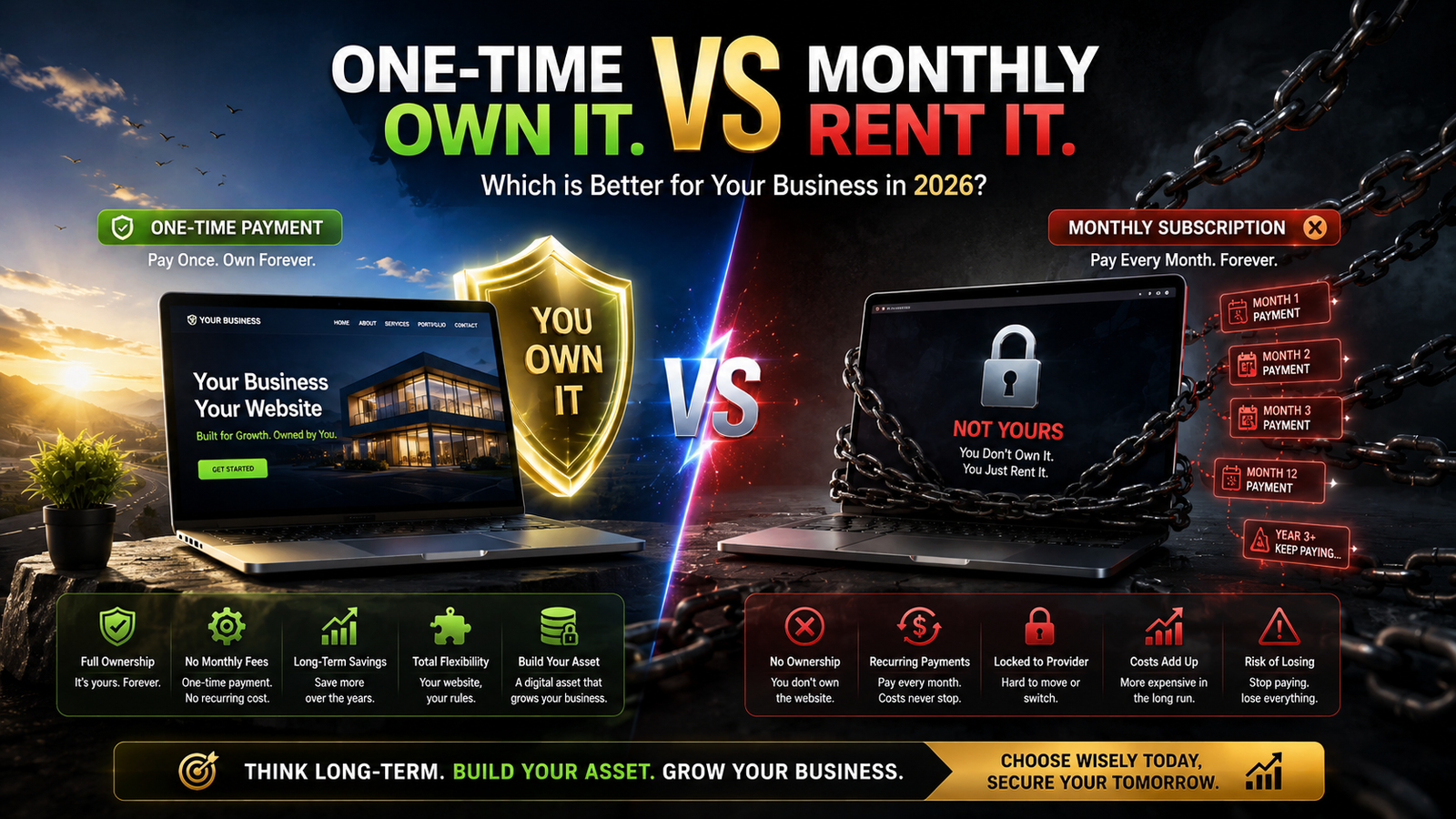
When a business needs a website, one of the first decisions is not always about design, technology or features. It is often about how the website will be paid for.
Should you pay for a website once and own the project, or choose a monthly website subscription with a smaller recurring payment?
Monthly website plans can look attractive because the initial cost is low. A business may see an offer for a website at a relatively small monthly fee and feel that it is easier to manage than paying a larger amount upfront.
However, the monthly price is only one part of the equation.
If you plan to keep your website for several years, the total amount you pay can become significantly more important than the initial monthly price.
That is why businesses should compare the total cost of ownership, what they actually own, what services are included and what happens when they stop paying.
This guide explains the differences between one-time website purchases and monthly website subscriptions, including their advantages, disadvantages, long-term costs and situations where each model can make sense.
What Is a One-Time Website Purchase?
A one-time website purchase generally means paying a development fee to have a website designed and built for your business.
Depending on the agreement, this may include:
• Website design and development • Custom pages and functionality • Responsive mobile design • Content integration • Contact forms • Basic SEO setup • Database or backend functionality • Integrations • Testing and deployment
Once the development project is completed, the business can own the website and its agreed-upon assets according to the contract.
This does not necessarily mean that there are no future expenses.
A website may still require domain renewal, hosting, security updates, maintenance, premium software licences, API usage or additional development work.
The important difference is that the development cost itself does not necessarily continue every month.
What Is a Monthly Website Subscription?
A monthly website subscription is a recurring payment model where a business pays a fixed amount each month for access to a website and potentially other services.
Depending on the provider, the package may include:
• Website hosting • Website design • Maintenance • Technical support • Content updates • Security updates • Website management • Domain services • Software features
The exact terms vary significantly between providers.
Some monthly plans may provide a managed service, while others may effectively operate as a website rental or subscription platform.
That is why businesses should always read the agreement carefully before signing up.
One-Time Website vs Monthly Subscription
The biggest difference is simple:
One-time model: Pay for development → own the agreed website/assets → pay separately for ongoing services when required.
Monthly model: Pay a recurring fee → receive website access and bundled services according to the subscription agreement.
Neither model is automatically right for every business.
The better choice depends on budget, ownership, required services and how long the business expects to use the website.
The Real Cost of a Monthly Website
A monthly payment can look inexpensive when viewed in isolation.
For example, imagine a website plan costing ₹2,000 per month.
At first, ₹2,000 may seem much easier than paying ₹60,000 upfront.
But look at the cost over time.
1 year:
₹2,000 × 12 = ₹24,000
3 years:
₹2,000 × 36 = ₹72,000
5 years:
₹2,000 × 60 = ₹1,20,000
7 years:
₹2,000 × 84 = ₹1,68,000
The same principle applies to any currency.
For example, a $50 monthly plan costs:
1 year: $600
3 years: $1,800
5 years: $3,000
This does not mean a monthly website is necessarily a bad deal.
The monthly fee may include hosting, maintenance, support, updates and other services that would otherwise need to be paid for separately.
The point is simply that businesses should calculate the total cost over the period they expect to use the website.
Why One-Time Ownership Can Be Better Long Term
For businesses planning to keep a website for many years, one-time development can provide significant long-term advantages.
The first is the potential reduction in recurring development costs.
Once the initial website has been built and paid for, you are not necessarily paying the same development fee every month simply to keep the website available.
The second advantage is ownership.
If the agreement gives you ownership of the website, source code and relevant assets, you have more control over your digital property.
The third advantage is flexibility.
You may be able to choose your own hosting provider, maintenance company or developer rather than remaining tied to a single subscription provider.
The fourth advantage is long-term value.
A professionally developed website can become a business asset rather than an ongoing rental expense.
Ownership Matters
One of the most important questions businesses should ask before choosing a monthly website plan is:
"What exactly do I own?"
A low monthly price can sometimes come with restrictions.
For example, depending on the contract:
• You may not own the source code. • You may not be able to move the website to another provider. • The website may stop working when payments stop. • Some features may only remain available while the subscription is active. • Your data or content may have limited portability.
These conditions are not automatically bad.
A subscription provider may be offering a managed service, and that service can be valuable.
But businesses should understand the difference between paying for a service and owning an asset.
Before signing any agreement, check the ownership and cancellation terms.
The Advantages of a One-Time Website
1. Greater Ownership
A properly structured one-time development agreement can give the business ownership of the website and agreed digital assets.
This can provide greater control over the future of the website.
2. Potential Long-Term Savings
If the website is expected to remain active for several years, avoiding recurring development subscription fees can potentially reduce the total cost.
The savings depend on the original development cost and the ongoing costs of hosting, maintenance and updates.
3. More Flexibility
Owning your website can make it easier to work with different developers, hosting providers or maintenance teams, subject to the technology and contract terms.
4. Custom Development
A one-time custom website can be designed around the actual needs of a business rather than forcing the business into a standard subscription package.
5. Better Long-Term Planning
Once the initial development is complete, the business can plan its future costs separately.
Instead of one bundled monthly charge, you can decide when you need maintenance, upgrades or additional features.
The Disadvantages of a One-Time Website
A one-time purchase also has disadvantages.
1. Higher Upfront Investment
The biggest challenge is the initial cost.
A custom website may require a larger payment at the beginning compared with a low-cost monthly subscription.
2. Maintenance May Be Separate
A website does not maintain itself forever.
Security updates, technical improvements, backups, content changes and new features may require additional costs.
3. You May Need Technical Support
If something breaks after the initial development period, you may need to pay a developer or maintenance provider to fix it.
4. Responsibility Can Be Higher
With ownership comes responsibility.
The business needs to understand hosting, backups, security, domains and maintenance or work with someone who can manage them.
The Advantages of a Monthly Website
Monthly subscriptions can be a practical option in the right situation.
1. Lower Initial Cost
The biggest advantage is usually the lower upfront investment.
A small business may prefer to spread costs over time rather than spend a large amount at once.
2. Predictable Monthly Expenses
A fixed monthly payment can make budgeting easier.
3. Maintenance May Be Included
Some plans include hosting, technical support, updates and maintenance.
This can be useful for businesses that do not want to manage technical tasks themselves.
4. Easier Entry for New Businesses
A startup or small business with limited capital may find a subscription easier to start with.
The Disadvantages of a Monthly Website
1. Long-Term Costs Can Add Up
A small monthly fee can become a substantial amount over several years.
2. Ownership Can Vary
Not every monthly plan gives you ownership of the website, source code or underlying platform.
3. Provider Dependency
Depending on the agreement and technology, moving away from the provider may be difficult.
4. Cancellation Terms Matter
You need to know what happens to your website, content and data if you stop paying.
5. You May Pay for Services You Don't Need
Some packages bundle services together.
If you only need a website but are paying every month for additional services you rarely use, the subscription may not provide the best value.
One-Time vs Monthly: A Simple Comparison
One-Time Website vs Monthly Subscription: Which Is Better for Your Business in 2026?
One-Time Website
Upfront cost: Higher
Recurring development payment: Usually no
Ownership: Can be included depending on contract
Customization: Generally high
Long-term cost: Potentially lower
Hosting: Usually separate
Maintenance: May be separate
Provider flexibility: Generally greater if assets are transferable
Best for: Businesses planning long-term website ownership
Monthly Subscription
Upfront cost: Lower
Recurring payment: Yes
Ownership: Depends on agreement
Customization: Depends on provider
Long-term cost: Can become higher
Hosting: Often bundled
Maintenance: May be included
Provider flexibility: Depends on platform and contract
Best for: Businesses that value low upfront costs and managed services
How Much Can You Save With a One-Time Website?
The answer depends on the numbers.
Suppose a business is comparing:
One-time development:
₹60,000
Monthly subscription:
₹2,000 per month
After three years, the subscription would cost:
₹2,000 × 36 = ₹72,000
At five years:
₹2,000 × 60 = ₹1,20,000
At seven years:
₹2,000 × 84 = ₹1,68,000
If the one-time website costs ₹60,000 and remains useful for five years, the business has potentially avoided ₹60,000 in additional development subscription payments compared with the example monthly model.
However, this is not a pure saving calculation.
The one-time website may still have expenses such as:
• Domain • Hosting • Maintenance • Security • Backups • Updates • Premium plugins • API services • Additional development
The correct comparison is therefore:
Total cost of one-time ownership
versus
Total cost of the monthly subscription over the same period.
This is called the total cost of ownership.
Why the 3-Year and 5-Year View Matters
Businesses often make purchasing decisions based on the first month or first year.
That can be misleading.
A website is normally expected to support a business for multiple years.
Instead of asking:
"How much does this cost per month?"
Ask:
"How much will this cost me over three years?"
Then ask:
"How much will it cost over five years?"
This simple calculation can completely change the decision.
A monthly plan that looks affordable at first may become expensive over time.
At the same time, a one-time website that appears expensive initially may become more economical over a longer period.
The Best Choice Depends on Your Business
There is no universal winner.
A monthly website may be the right choice if:
• You want to minimize upfront spending. • You prefer predictable monthly payments. • Maintenance and support are included. • You don't want to manage technical infrastructure. • You are comfortable with the ownership and cancellation terms.
A one-time website may be the better option if:
• You want to own your website. • You expect to use it for several years. • You want greater control over your digital assets. • You need custom functionality. • You want freedom to choose your hosting or developers. • You want to reduce recurring development costs over time.
What About Hosting, Maintenance and Updates?
This is where many comparisons become misleading.
Buying a website once does not mean the website will never have another expense.
A website can require ongoing services.
For example:
Domain renewal keeps your domain name registered.
Hosting keeps your website files and database available online.
Security maintenance helps protect the website.
Software updates help keep systems compatible and secure.
Backups help protect against data loss.
Technical support helps resolve unexpected problems.
New features require additional development.
These are legitimate ongoing costs.
The important difference is that you can often purchase these services separately rather than paying a permanent development subscription simply to retain access to the website.
Questions to Ask Before Choosing a Monthly Website Plan
Before signing up, ask the provider:
Who owns the website?
Do I own the source code?
Can I move the website to another hosting provider?
What happens if I cancel?
Will I keep my content and database?
Is the domain registered in my name?
What services are included in the monthly fee?
Are updates included?
Is technical support included?
Are there cancellation charges?
What will the total cost be after three years?
What will the total cost be after five years?
These questions can reveal the real value of a plan.
Questions to Ask Before Buying a One-Time Website
A one-time project also needs careful evaluation.
Ask:
What exactly is included in the development cost?
Who owns the source code?
Who owns the design and content?
Is hosting included?
How long is post-launch support provided?
Are security updates included?
How much does future maintenance cost?
Can another developer work on the website?
Are there any third-party licences?
What happens if I need new features later?
A low one-time price isn't automatically a good deal either.
The website still needs to be reliable, secure, maintainable and suitable for the business.
The Real Question Is Ownership vs Convenience
Ultimately, the choice comes down to two different approaches.
A monthly subscription often focuses on convenience.
You pay regularly and receive a package of services.
A one-time purchase focuses more on ownership.
You make a larger initial investment and then manage or separately purchase the services needed to keep the website running.
Neither model is inherently wrong.
The right option depends on what the business values most.
Final Verdict: Which Is Better?
For a business planning to use its website for many years, a one-time website purchase can often provide stronger long-term value, greater ownership and more flexibility.
It can also potentially reduce total costs when compared with a recurring development subscription.
However, businesses should not assume that every one-time website will be cheaper.
The development quality, hosting costs, maintenance, security, updates and additional services all matter.
Monthly subscriptions can be a smart choice for businesses that value lower upfront costs, predictable payments and managed services.
The best decision is therefore not simply:
"One-time or monthly?"
The better question is:
"What will I own, what services am I receiving, and what will this website actually cost me over the next three to five years?"
Think Beyond the Monthly Price
A website is not just another monthly expense.
For many businesses, it becomes one of their most important digital assets.
It represents the company online, generates enquiries, supports sales, builds trust and can continue working for the business around the clock.
That is why the purchasing decision deserves more than a comparison of monthly prices.
Look at ownership.
Look at flexibility.
Look at the total cost.
Look at what happens if you stop paying.
And most importantly, look at the value the website can provide over the next several years.
For businesses that want long-term control and are prepared to make the initial investment, owning a professionally developed website can be a smarter long-term strategy than continuously paying for access.
The goal isn't simply to find the cheapest website.
The goal is to build a digital asset that continues to create value for your business.
Want Help With This?
Let's talk about how this applies to your business.