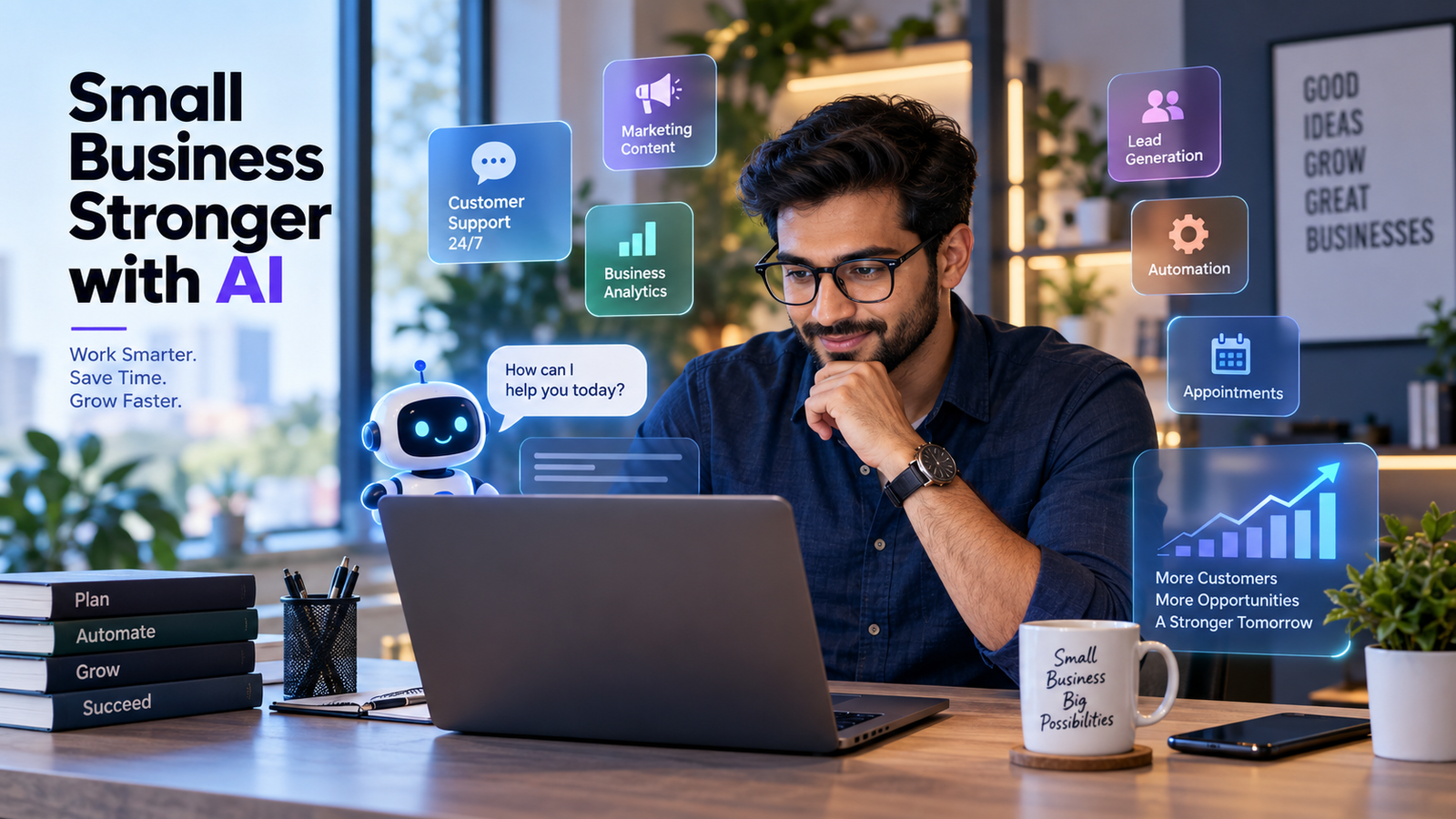
Artificial intelligence is no longer limited to large companies with big technology budgets. Small businesses can now use AI to save time, improve customer service, streamline daily operations, and create better marketing campaigns.
The key is not to use AI everywhere at once. Instead, businesses should identify specific problems where AI can provide practical value and introduce it gradually.
Why Should Small Businesses Use AI?
Small businesses often have limited teams, which means employees may have to manage multiple responsibilities. A business owner might handle sales, customer enquiries, marketing, administration, and operations at the same time.
AI can help reduce repetitive work and allow people to spend more time on tasks that require creativity, communication, and decision-making.
Some common uses include:
Creating marketing content Answering frequently asked questions Managing customer enquiries Summarizing documents Generating reports Automating repetitive workflows Analyzing business information Assisting with sales and follow-ups
The goal should be to use AI as a tool that supports employees rather than simply trying to replace human work.
1. Start With Repetitive Tasks
The easiest way to introduce AI is to look at tasks your business performs repeatedly.
For example, employees may spend hours responding to similar emails, preparing reports, entering information, writing product descriptions, or answering basic customer questions.
Make a list of these repetitive activities and identify which ones could be assisted or automated.
Starting with one simple task makes it easier to test the technology and measure its impact.
2. Use AI for Customer Support
Customer support is one of the most useful areas for AI.
An AI-powered chatbot can help answer common questions about products, services, pricing, business hours, booking processes, or frequently requested information.
For example, a local service business could add an AI assistant to its website that helps visitors understand available services and collects their contact information when they want to make an enquiry.
AI can handle simple questions instantly while more complicated issues can be passed to a human employee.
This can help businesses provide faster responses without requiring someone to answer the same questions repeatedly.
3. Use AI for Marketing
Creating marketing content consistently can be difficult for a small team.
AI can assist with:
Blog ideas Social media content Email campaigns Advertisement copy Product descriptions Website content Content outlines SEO research
However, businesses should not simply publish everything generated by AI without reviewing it.
Human editing is important because AI-generated content can contain inaccurate information or fail to properly represent a company's experience and brand voice.
The best approach is to use AI as an assistant while keeping human expertise at the center of the content.
4. Use AI to Generate and Organize Leads
AI can also help businesses manage potential customers.
A website enquiry form can collect important information such as the service required, approximate budget, location, and expected timeline.
An AI-powered workflow can then organize these enquiries and help the sales team understand which leads require attention.
For example:
Website enquiry → Lead captured → Information analyzed → Lead categorized → Sales follow-up
This can reduce the amount of manual work involved in organizing incoming enquiries.
5. Make Your Business Website Smarter
A business website does not have to be just a digital brochure.
AI can add useful features such as:
AI chat assistants Automated enquiry collection Appointment assistance Product recommendations FAQ assistants Lead qualification Personalized experiences Automated follow-ups
For businesses that depend on enquiries, bookings, or online sales, these features can turn the website into an active part of the customer journey.
6. Automate Customer Follow-Ups
Potential customers do not always make a decision immediately.
Someone might submit an enquiry today but need several days before deciding whether to purchase a product or service.
AI and automation can help businesses organize follow-ups and make sure important enquiries are not forgotten.
A simple workflow could look like this:
Customer submits enquiry → CRM records the lead → Initial response is sent → Follow-up reminder is created → Sales team contacts the customer
The exact process will depend on the business, but even simple automation can reduce repetitive administrative work.
7. Use AI to Understand Business Data
Small businesses already generate valuable data through sales, websites, advertising, customer enquiries, appointments, and other systems.
AI can help summarize this information and identify useful patterns.
For example, a business could analyze:
Which services receive the most enquiries Which products sell the most Which marketing channels generate leads When customer demand increases Which types of customers make repeat purchases
AI does not replace proper business analysis, but it can make large amounts of information easier to understand.
8. Improve Employee Productivity
AI can also assist employees with everyday tasks.
Teams can use AI to:
Summarize long documents Prepare meeting notes Draft emails Create checklists Organize information Generate first drafts Assist with research Explain complex topics
For small teams, saving a few hours every week on repetitive tasks can make a meaningful difference.
9. Protect Business and Customer Data
AI adoption should always include data security considerations.
Businesses should understand what information they are sharing with AI tools and how those tools handle the information.
Avoid unnecessarily entering sensitive customer information, passwords, financial details, confidential documents, or other private business information into public AI services.
Businesses should also establish clear guidelines for employees covering:
Which AI tools can be used What information can be shared When human review is required How customer information should be handled Who is responsible for checking AI-generated output
Using AI responsibly is just as important as using it effectively.
10. Don't Try to Automate Everything
One common mistake is trying to introduce AI into every part of a business at the same time.
A better approach is to start with one specific problem.
For example:
Problem: Employees spend several hours every day answering repetitive customer questions.
Solution: Introduce an AI assistant that handles frequently asked questions.
Measure: Track response time, conversations handled, and how many conversations need human assistance.
If the results are useful, the business can gradually introduce AI into another workflow.
How Small Businesses Can Start Using AI
A Simple 30-Day AI Plan for Small Businesses
Small businesses can begin their AI journey with a simple four-week plan.
Week 1: Identify Opportunities
List the repetitive tasks your team performs every day or every week.
Estimate how much time is spent on each task.
Week 2: Select One Use Case
Choose one process where AI could provide measurable value.
Start with something simple rather than attempting a complex transformation.
Week 3: Test the Workflow
Run the AI solution alongside your existing process.
Check the quality of its results and identify situations where human review is required.
Week 4: Measure the Results
Compare the new workflow with the old one.
Consider factors such as:
Time saved Cost Customer response time Employee workload Number of leads handled Quality of results
If the results are positive, continue improving the workflow.
Common AI Mistakes Small Businesses Should Avoid Using AI Without a Clear Goal
Don't adopt AI simply because it is popular. Start with a real business problem.
Publishing AI Content Without Reviewing It
AI can make mistakes. Always review important information before publishing or sending it to customers.
Automating Important Decisions Completely
Some decisions require human judgment, particularly when they involve customers, employees, finances, or sensitive business matters.
Using Too Many AI Tools
A large collection of disconnected tools can make business processes more complicated. Choose tools based on actual requirements.
Ignoring Data Security
Create clear rules for how customer and business information should be handled before employees begin using AI regularly.
What Can AI Help Small Businesses Achieve?
When implemented thoughtfully, AI can support different areas of a small business.
Customer service: Faster responses and easier access to information.
Marketing: Faster content creation, research, and campaign support.
Sales: Better lead organization and follow-up.
Operations: Less repetitive administrative work.
Management: Easier access to reports and business insights.
The actual benefits will depend on the business, its existing technology, and how AI is implemented.
The Future of AI for Small Businesses
AI technology is becoming increasingly integrated into websites, CRM systems, marketing platforms, accounting software, communication tools, and other business applications.
Small businesses do not necessarily need to build their own AI systems from scratch. They can use existing technologies and integrate them into workflows that solve specific business problems.
As these tools become more accessible, businesses will have more opportunities to automate routine work while keeping human expertise involved where it matters most.
Final Thoughts
Starting with AI does not require a massive technology investment or a complete change to the way a business operates.
The best starting point is simple: identify one repetitive problem, find an appropriate AI solution, test it, measure the results, and improve the workflow.
Whether it is customer support, marketing, lead generation, reporting, or employee productivity, AI can help small businesses work more efficiently when it is applied thoughtfully.
The goal is not simply to use AI because it is new. The goal is to use the right technology to solve real business problems and create better experiences for both customers and employees.
Want Help With This?
Let's talk about how this applies to your business.