Artificial intelligence has become one of the biggest technology shifts of the decade.
AI assistants, generative AI, image generation, coding tools, autonomous systems and AI agents are now becoming part of everyday technology.
But behind many of these systems is something that users rarely see: enormous amounts of computing power.
This is where NVIDIA enters the story.
NVIDIA is widely known for its graphics processing units, or GPUs. The company originally became famous for computer graphics and gaming, but its technology eventually became a critical part of modern artificial intelligence infrastructure.
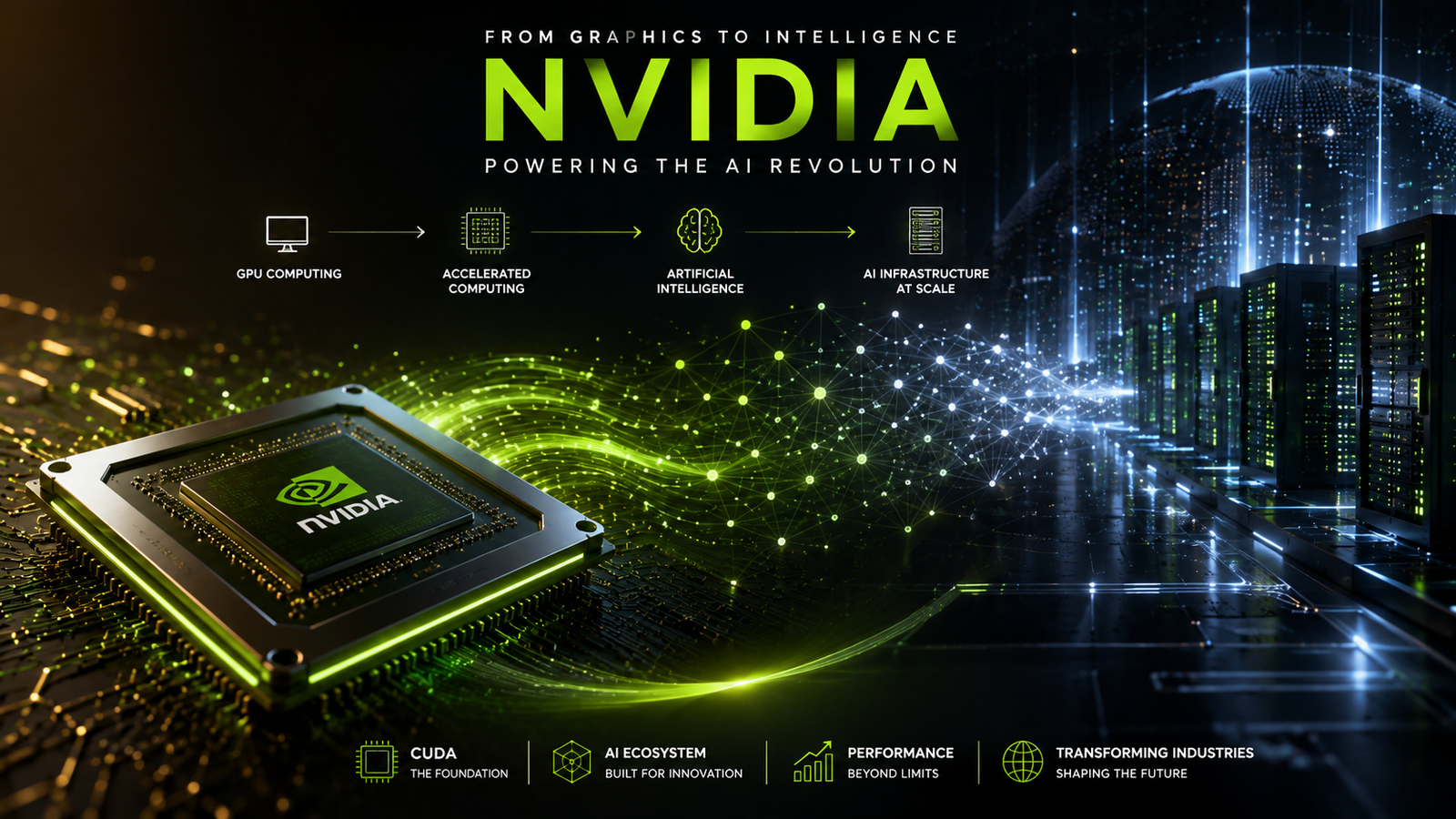
From CUDA and GPU computing to today's Blackwell and Vera Rubin platforms, NVIDIA has spent years building the hardware, software and networking technologies that help AI systems train and run at increasingly large scales.
So how did NVIDIA become so important to AI?
Let's go back to the beginning.
NVIDIA Wasn't Created for AI
NVIDIA was founded in 1993 with a focus on computer graphics and 3D visual computing.
The company became closely associated with GPUs, processors designed to perform many calculations in parallel.
At first, the primary applications were graphics, gaming and visual computing.
But GPUs had another important characteristic.
They could perform large numbers of parallel calculations.
That capability eventually became extremely useful for scientific computing and machine learning.
This shift from graphics to general-purpose accelerated computing became one of the most important parts of NVIDIA's long-term strategy.
CUDA Changed What GPUs Could Be Used For
One of NVIDIA's most important decisions came in 2006 with CUDA.
CUDA allowed developers to use NVIDIA GPUs for general-purpose computing instead of limiting them to graphics workloads.
This created a software platform around NVIDIA's hardware and enabled developers and researchers to use GPU acceleration for many different computational workloads.
Over time, GPU computing became increasingly important for deep learning.
NVIDIA's own documentation describes CUDA as a platform and programming model that enables computational workloads to use the parallel processing capabilities of GPUs.
This was a major turning point because AI research increasingly required enormous amounts of computation.
The AI Breakthrough That Changed Everything
The growth of deep learning accelerated significantly during the early 2010s.
One particularly important milestone was AlexNet, a deep neural network that achieved a major breakthrough in image recognition.
The system used GPUs to accelerate its training.
This demonstrated something important to the technology industry:
GPUs weren't only useful for rendering graphics.
They could also accelerate the mathematical operations required by deep neural networks.
From that point forward, GPUs became increasingly important to machine learning research and development.
NVIDIA's own corporate history identifies the 2012 AlexNet breakthrough as a major milestone in its role in modern AI.
The Rise of Generative AI
The next major transformation came with increasingly capable neural networks, large language models and generative AI.
Training these systems requires enormous computational resources.
AI companies need infrastructure capable of processing huge datasets and performing massive numbers of mathematical operations during training.
After training, the models also need powerful infrastructure to respond to millions or billions of user requests.
This created two major computing challenges:
AI training
AI inference
Training is the process of teaching a model using large amounts of data.
Inference is what happens when the trained model generates an answer, prediction, image, recommendation or other output.
Both require significant computing resources at scale.
This is where NVIDIA's ecosystem became increasingly important.
NVIDIA Built More Than GPUs
One reason NVIDIA's influence on AI goes beyond simply making powerful chips is its broader technology ecosystem.
The company has developed technologies covering multiple parts of accelerated computing, including:
• GPUs • CUDA • AI libraries • Networking • Interconnect technologies • Data-center systems • AI software • Developer tools • Inference technologies • Enterprise AI platforms
This approach helped turn NVIDIA hardware into part of a broader computing platform.
Developers and organizations can build AI systems using hardware and software designed to work together.
That ecosystem effect is an important part of understanding NVIDIA's position in AI.
Blackwell and the Era of Large-Scale AI
As AI models became larger and more complex, the infrastructure required to run them also changed.
NVIDIA introduced the Blackwell architecture in 2024 as a platform designed for large-scale AI training and inference.
Blackwell includes GPU technology, networking and other infrastructure designed to operate at data-center scale.
NVIDIA also introduced rack-scale systems such as the GB200 Grace Blackwell platform for demanding generative AI workloads.
The important shift here is that AI computing is no longer simply about buying a faster GPU.
Large AI systems require:
• Multiple GPUs • High-bandwidth memory • Fast networking • Efficient data movement • Advanced cooling • Storage • Power infrastructure • Software optimisation • System-level orchestration
The AI industry is therefore moving toward complete AI infrastructure rather than isolated processors.
From Data Centers to AI Factories
One of NVIDIA's biggest ideas in recent years has been the concept of the "AI factory."
Traditional data centers primarily process and store information.
AI factories are designed around continuously producing intelligence through AI workloads.
That means the infrastructure needs to support the entire AI pipeline.
Data enters the system.
Models process that data.
AI systems generate outputs.
Those outputs can then be used by applications, businesses, researchers and consumers.
In 2026, NVIDIA has continued expanding this idea with its DSX platform.
The DSX platform is designed to help infrastructure builders design, simulate, deploy and operate large-scale AI factories.
It brings together computing, networking, software, facilities and other infrastructure considerations.
This shows how NVIDIA's role is expanding from individual chips toward complete AI infrastructure.
Vera Rubin: NVIDIA's Next AI Platform
In 2026, NVIDIA has continued moving beyond Blackwell with its Vera Rubin platform.
The Vera Rubin platform combines multiple components designed to work together as a large-scale AI system.
These include:
• NVIDIA Vera CPU • NVIDIA Rubin GPU • NVLink networking • ConnectX networking • BlueField data processing units • Spectrum networking
The goal is to support different stages of modern AI workloads, including training, post-training, test-time scaling and AI inference.
This is particularly relevant as AI systems become more capable of reasoning and operating as agents.
Instead of AI simply responding to a single prompt, future systems can perform multiple steps, use tools, process information and complete tasks.
That creates new infrastructure requirements.
AI Agents Need More Computing
The next phase of AI may not be defined only by larger chatbots.
AI agents are becoming an increasingly important area of development.
An AI agent can potentially:
• Understand a goal • Plan multiple steps • Use software tools • Access information • Generate and evaluate outputs • Perform actions • Continue working toward an objective
These workflows can require significantly more computation than a simple question-and-answer interaction.
NVIDIA's 2026 Vera Rubin platform is being designed around this changing workload.
The company has described the platform as infrastructure for agentic AI and large-scale AI factories.
This illustrates an important trend:
AI infrastructure is increasingly being designed around the amount of intelligence a system can produce, not simply around raw computing performance.
AI Is Becoming a Global Infrastructure Race
Another important development is that AI infrastructure is no longer limited to a small group of technology companies.
Countries, cloud providers, enterprises and research organisations are investing in large-scale AI computing.
In July 2026, NVIDIA announced a partnership in Japan to build a national AI infrastructure project based on Vera Rubin technology.
The planned system is intended to support applications across areas including manufacturing, logistics, healthcare, telecommunications and physical AI.
NVIDIA has also announced large-scale AI infrastructure initiatives with partners in other regions.
This represents a broader shift.
AI infrastructure is increasingly becoming part of national technology strategy.
Why Does NVIDIA Matter So Much to AI?
There isn't one single reason.
NVIDIA's position has developed through several layers of technology.
First, its GPUs provide highly parallel computing.
Second, CUDA created a programming ecosystem around those GPUs.
Third, NVIDIA developed specialised AI libraries and software.
Fourth, the company built high-speed networking and interconnect technologies.
Fifth, it expanded into complete data-center and AI factory systems.
Together, these technologies create an ecosystem that can support AI from development through large-scale deployment.
This is one reason NVIDIA's impact on AI is bigger than simply selling graphics processors.
The AI Supply Chain Is Much Bigger Than NVIDIA
It is also important to understand that NVIDIA does not build the entire AI industry alone.
Modern AI infrastructure depends on a massive global ecosystem.
That includes:
• Semiconductor manufacturers • Memory manufacturers • Data-center operators • Cloud providers • Networking companies • Cooling providers • Power infrastructure • Server manufacturers • Software developers • AI research organisations • Model developers
For example, NVIDIA works with semiconductor and manufacturing partners to produce advanced systems.
It also works with cloud providers, server manufacturers and infrastructure companies to deploy AI computing at scale.
This means the AI revolution is not simply a story about one company.
It is a story about an entire technology ecosystem.
NVIDIA's Impact on Different Industries
The infrastructure NVIDIA has developed is being used across many areas of technology and research.
How NVIDIA Changed AI: From Graphics Cards to the Infrastructure Powering Modern AI
Generative AI
Large language models and other generative AI systems require large amounts of accelerated computing for training and inference.
Healthcare
AI can be used for medical imaging, drug discovery, simulation and research.
Robotics
Robotics increasingly combines computer vision, AI models and real-time decision-making.
Scientific Research
High-performance computing and AI can accelerate simulations and research in areas such as climate science, physics and energy.
Manufacturing
AI can support automation, inspection, simulation and industrial optimisation.
Automotive
AI computing is being used in autonomous driving research, simulation and intelligent vehicle systems.
Content Creation
GPU acceleration powers workflows involving graphics, video, 3D rendering and increasingly AI-based creative tools.
The result is that NVIDIA's technology is becoming relevant far beyond gaming.
The Shift From Training AI to Running AI
One of the most important changes happening now is the growing importance of inference.
In the early generative AI boom, much of the focus was on training increasingly large models.
But once a model has been trained, it needs to serve real users.
Every question, generated image, recommendation, coding task or AI-agent action requires computing.
As AI becomes integrated into more applications, inference demand can become enormous.
This changes what infrastructure companies need to optimise.
The challenge is no longer simply:
"How fast can we train this model?"
It is also:
"How efficiently can we run AI at massive scale?"
This is one of the reasons NVIDIA's newer platforms increasingly focus on inference efficiency, networking, memory and system-level performance.
What NVIDIA Has Changed About Computing
Perhaps the biggest impact of NVIDIA is that it helped change the way the technology industry thinks about computing.
For decades, CPUs were the primary general-purpose processors used by most applications.
GPUs were associated mainly with graphics.
The rise of accelerated computing changed that relationship.
Today, large AI systems combine CPUs, GPUs, networking, memory, storage and specialised software.
Computing is increasingly becoming heterogeneous.
Different processors perform different jobs.
The result is a new computing architecture built around acceleration.
And AI is one of the biggest forces driving that transition.
Is NVIDIA the Only Company Building AI Infrastructure?
No.
The AI infrastructure market is highly competitive.
Companies such as AMD, Intel, Google, Amazon, Microsoft and many specialised semiconductor and infrastructure companies are developing technologies for AI workloads.
Cloud providers are also building their own accelerators.
AI companies and research organisations are exploring different hardware and software architectures.
This competition is important because AI infrastructure is still evolving.
NVIDIA currently has a particularly broad ecosystem across GPUs, software, networking and systems, but the industry is not standing still.
The Future of AI Infrastructure
The next phase of AI could require even more computing.
AI models are becoming more capable.
AI agents are becoming more complex.
Multimodal systems are processing text, images, audio and video.
Robotics is bringing AI into the physical world.
Scientific AI is expanding.
Enterprise AI adoption is increasing.
All of these applications require infrastructure.
That means future AI progress will depend not only on better algorithms and models, but also on:
• Computing power • Energy efficiency • Memory • Networking • Data centers • Cooling • Software • Chip design • Cloud infrastructure
NVIDIA is attempting to address many of these areas simultaneously.
What Businesses Should Learn From NVIDIA's AI Strategy
There is an important lesson here for businesses.
AI is not just about using a chatbot.
The biggest transformation is happening across the entire technology stack.
Businesses are increasingly using AI for:
• Customer support • Marketing • Software development • Data analysis • Content creation • Automation • Research • Sales • Business intelligence • Workflow optimisation
As AI becomes more accessible, businesses don't necessarily need to build their own foundation models.
Instead, they can use existing AI infrastructure and services to build practical solutions.
The companies that benefit most may be those that understand how to integrate AI into real business processes rather than simply experimenting with AI tools.
Final Thoughts
NVIDIA did not create artificial intelligence.
AI research existed long before modern GPUs became central to the industry.
What NVIDIA helped change was the economics and scale of accelerated computing.
The company's GPUs, CUDA software ecosystem, networking technologies and data-center platforms helped make large-scale AI workloads increasingly practical.
From the early GPU computing era to CUDA, from the deep-learning breakthroughs of the 2010s to today's Blackwell and Vera Rubin platforms, NVIDIA has continued building infrastructure around increasingly demanding AI workloads.
And the story is still developing.
The next phase of AI may involve reasoning systems, AI agents, robotics, scientific computing and autonomous technologies.
All of them will need computing infrastructure.
That makes NVIDIA's story bigger than GPUs.
It is a story about how computing itself is changing to support the next generation of artificial intelligence.
At My Digital Creations, we follow the technologies shaping the future of digital business, AI, web development and online experiences.
As AI continues to evolve, understanding the infrastructure behind it can help businesses make smarter decisions about the technology they adopt next.
Want Help With This?
Let's talk about how this applies to your business.