For the past two years, "optimise for AI search" has been advice with no way to check your homework. You could write AEO-friendly content, add schema, structure your FAQs properly — and still have no idea whether ChatGPT, Copilot, or any AI tool was actually citing your site. That changed in 2026.
In February 2026, Microsoft launched the AI Performance report inside Bing Webmaster Tools — the first dashboard from a major search engine built specifically to show publishers how their content performs inside AI-generated answers. In June 2026, Microsoft expanded it with four new features: Intents, Topics, Citation Share, and Compare — all rolling out globally, free, in preview.
If you haven't looked at this yet, here's what it actually shows you, and how to use it.
What Citation Share Actually Measures
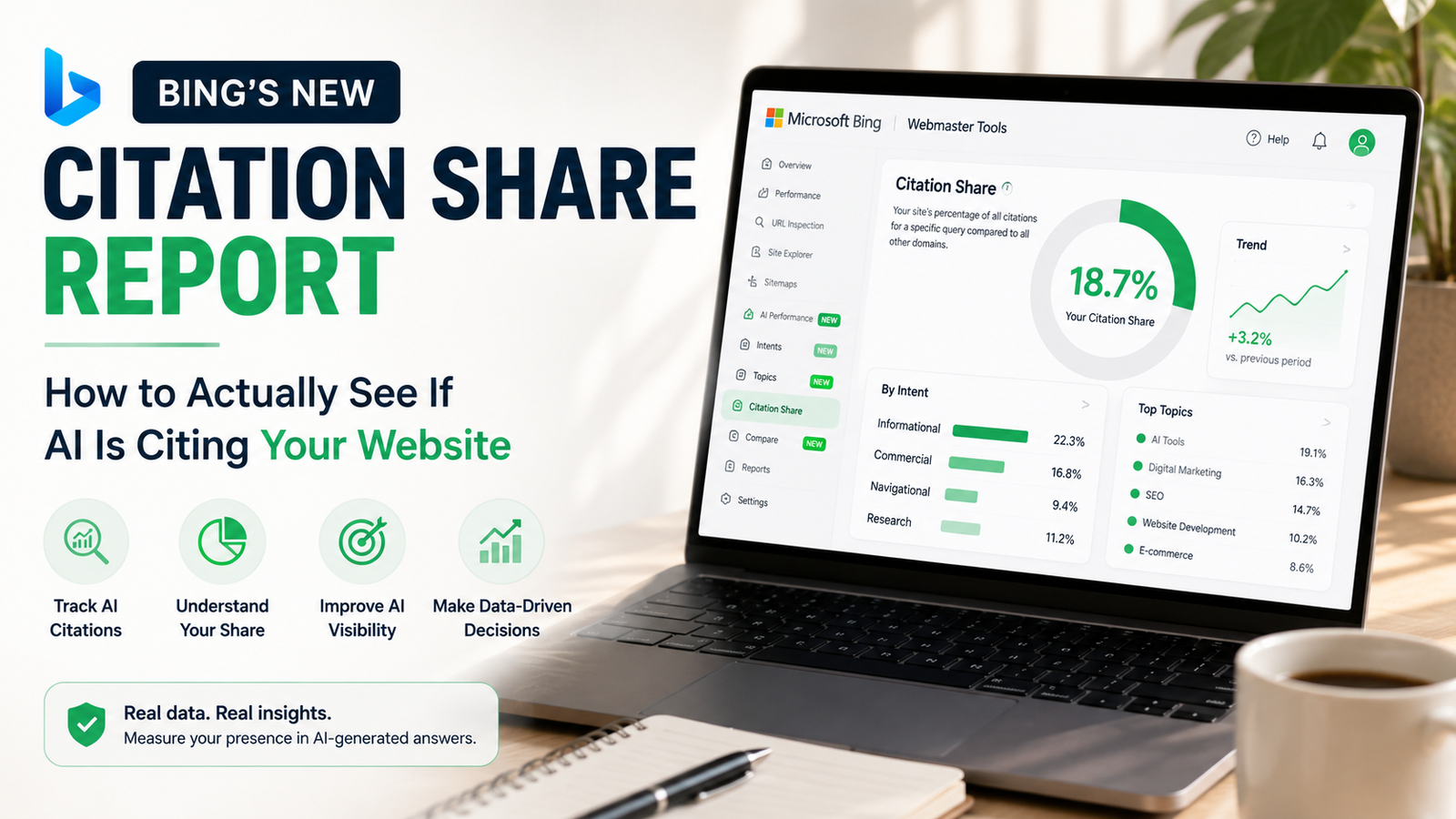
Citation Share shows your site's percentage of all citations for a specific query — not just how often you were cited, but what share of the citation "pie" you actually own compared to everyone else answering that query. Microsoft is clear that this is an observational metric: it doesn't expose which competitor domains you're losing share to, and it isn't a measure of traffic.
That distinction matters. This isn't a rank tracker. It's a way to see whether your content is actually being pulled into AI answers at all, and for which topics.
The Other Three New Features
Intents classifies the queries that triggered your citations into categories like Informational, Commercial, Navigational, and Research, so you can see whether AI tools are citing you for people just learning about a topic, or for people close to buying.
Topics groups your citations by subject area, showing you which parts of your site AI engines consider you an authority on.
Compare lets you overlay a previous time period against your current one, so you can see whether your citation activity is growing, shrinking, or shifting. Useful once you've been tracking for a few months.
Why This Matters Even If Most of Your Traffic Comes From Google
Bing holds a modest slice of global search share on its own, but its influence is bigger than that number suggests, because Bing's index is what several major AI answer tools lean on when pulling web results. If your site isn't indexed properly in Bing, some of those tools may struggle to find and cite you in the first place, regardless of how well you rank on Google.
There's also a broader point: AI search behaves the same way across engines. The content characteristics that earn citations on Bing tend to be the same ones that earn citations elsewhere. So even businesses with a Google-first audience get useful signal from this data.
How to Actually Check Your Numbers
1. Verify your site in Bing Webmaster Tools, if you haven't already. It's free and takes a few minutes.
2. Open the AI Performance report from the left-hand navigation menu.
3. Record your baseline: current total citations, and Citation Share broken down by Intent.
4. Check which Topics you're being cited for, and just as importantly, which relevant topics you're getting zero citations for. That's your content gap list.
5. Come back monthly and use Compare to see whether specific content changes (new pages, updated FAQs, restructured headings) actually moved the numbers.
Bing's New "Citation Share" Report: How to Actually See If AI Is Citing Your Website
What To Do If Your Numbers Are Low
Low or zero citations for topics you'd expect to rank for usually points to one of three things:
- Thin or generic content that doesn't answer the question directly and completely - Missing structure: no clear headings, no direct answers near the top of the page - Pages that aren't properly indexed in Bing at all, which is worth checking first before assuming a content problem
This is the same foundation good SEO has always rested on: clear, well-structured, genuinely useful content. AI citation tools like this one just make it measurable for the first time.
Conclusion
For years, "are we showing up in AI search?" has been a question businesses could only guess at. Citation Share doesn't answer everything. It won't show you competitor names, and it isn't traffic data, but it's the closest thing to real evidence currently available, for free, from a major search engine. If AI visibility matters to your business, this is worth five minutes this week, not someday.
If you want a second opinion on what your numbers are actually telling you, that's exactly the kind of thing worth talking through with someone who works in SEO and AEO daily.
Frequently Asked Questions
Is Bing Webmaster Tools free? Yes. Verifying your site and accessing the AI Performance report, including Citation Share, costs nothing.
Does Google have anything similar? Google Search Console has started rolling out its own AI visibility reporting, but as of mid-2026 it doesn't offer per-URL AI citation data the way Bing's Citation Share does.
Do I need a lot of traffic from Bing for this to matter? No. The value isn't Bing-specific traffic, it's that Bing's index feeds into how several AI tools pull and cite web content, so the data reflects your broader AI visibility, not just Bing's.
What does "Citation Share" actually tell me that citation count doesn't? Citation count tells you how often you're cited in absolute terms. Citation Share tells you your relative position: what percentage of all citations for that query you're capturing.
How often should I check this report? Monthly is reasonable for most small businesses, enough to spot real trends without over-reacting to daily noise.
Will this show me which competitors are beating me? No. Microsoft has confirmed the metric does not expose competitor domains. It shows your own share, not who's taking the rest of it.
Want Help With This?
Let's talk about how this applies to your business.