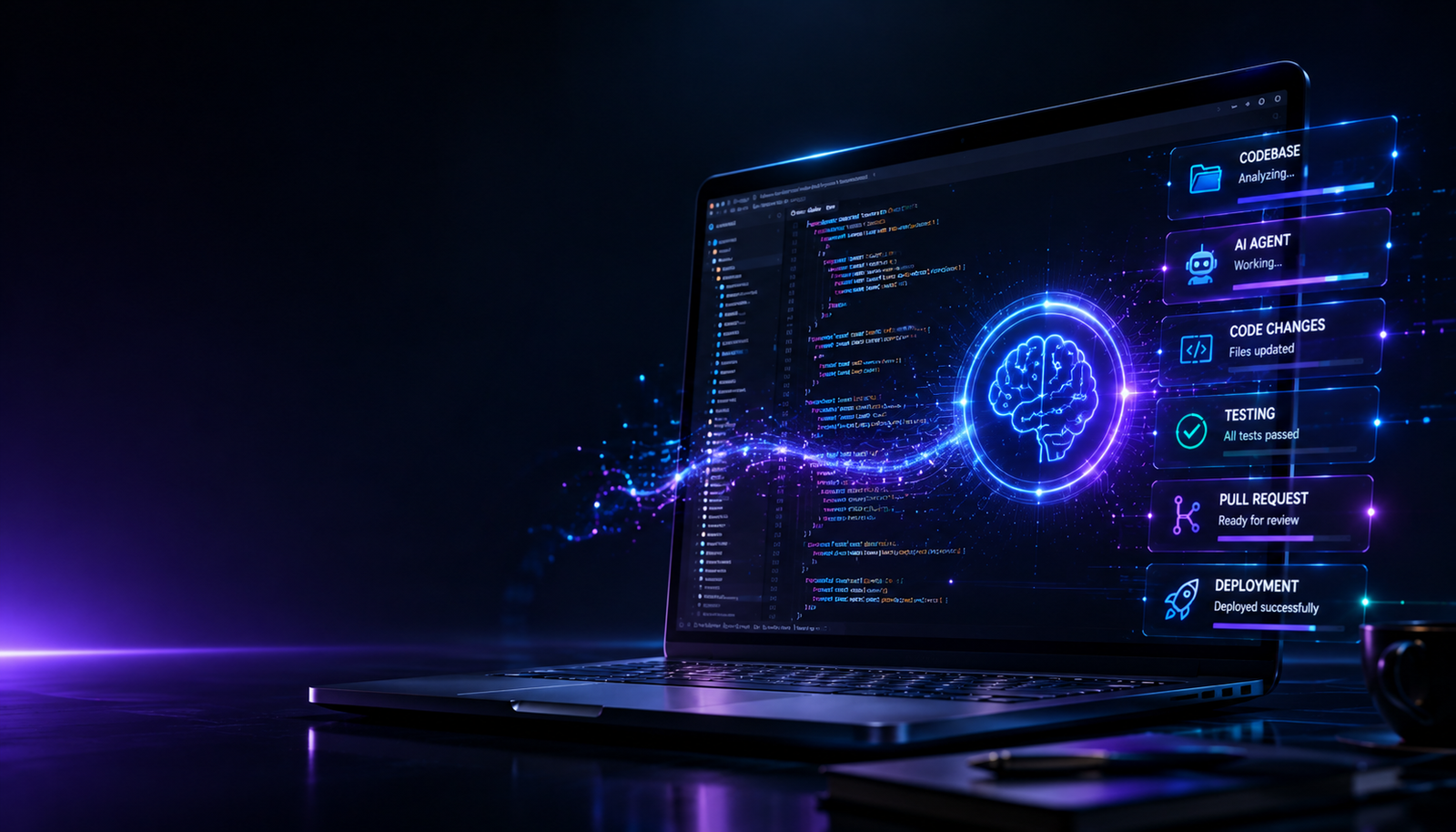
The Rise of AI Coding Agents: How Software Development Is Changing in 2026
Software development is entering a new phase.
For years, developers used programming languages, frameworks, IDEs, version control systems and increasingly powerful development tools to build software.
Then generative AI changed the workflow.
AI coding assistants could explain code, suggest functions, generate snippets and help developers solve programming problems.
But in 2026, the conversation is moving beyond simple code completion.
A new category of tools called AI coding agents is becoming increasingly important.
Instead of only suggesting the next few lines of code, coding agents can take a larger software task, understand a repository, create a plan, modify multiple files, run commands, execute tests, investigate errors and return the results for developer review.
This changes the relationship between developers and software.
The question is no longer simply:
"Can AI write code?"
The more interesting question is:
"How much of the software development process can AI agents handle?"
What Are AI Coding Agents?
AI coding agents are AI-powered systems designed to perform multi-step software engineering tasks with a greater level of autonomy than traditional code assistants.
A basic coding assistant might help you write a function.
A coding agent can potentially be given a task such as:
"Add user authentication to this application, update the database schema, create the required API endpoints, add tests and fix any issues you find."
The agent can then analyse the existing project, determine what needs to change, edit files, use development tools, run tests and iterate.
The developer remains responsible for reviewing the work and deciding what ultimately ships.
This distinction is important.
AI coding agents are not simply better autocomplete.
They are becoming development systems capable of planning and executing multi-step work.
AI Coding Assistants vs AI Coding Agents
The difference can be explained simply.
Traditional AI coding assistance:
Developer → Prompt → AI suggestion → Developer writes and edits code
Agentic coding:
Developer → Task → AI plans → AI edits → AI runs tools → AI tests → AI iterates → Developer reviews
The second workflow gives the AI a much larger role in the development process.
This doesn't necessarily remove the developer.
Instead, it can move the developer higher up the abstraction level.
The developer increasingly focuses on defining the problem, providing context, setting constraints, reviewing changes and deciding what should be shipped.
Why AI Coding Agents Are Becoming Important in 2026
The technology behind coding agents has improved rapidly.
Modern models are better at reasoning about codebases, following instructions, using tools and working through multi-step tasks.
At the same time, agent platforms are giving models access to development environments where they can inspect repositories, edit files, execute commands and test their changes.
GitHub's coding agent, for example, is designed to work asynchronously on software tasks and can create pull requests after completing work. Its 2026 updates added capabilities such as model selection, self-review, security scanning, custom agents and CLI handoff.
Other platforms are pursuing similar ideas.
OpenAI's Codex supports multiple agents and workflows designed around delegating software tasks.
Anthropic's Claude Code has developed from a command-line coding tool into a broader coding-agent workflow.
Google has also developed asynchronous coding-agent experiences.
Cursor has pushed cloud agents that can work in remote development environments and produce merge-ready pull requests.
The exact implementations differ, but the direction is similar.
AI is moving from:
"Help me write this code"
toward:
"Take care of this engineering task and show me what you changed."
From Code Generation to Software Engineering
Generating code is only one part of software development.
Real projects involve much more:
• Understanding an existing codebase • Planning changes • Finding dependencies • Editing multiple files • Working with databases • Running tests • Debugging errors • Reviewing code • Updating documentation • Managing pull requests • Checking security • Deploying applications • Monitoring production systems
Coding agents are increasingly being designed around these broader workflows.
This is one of the most important changes in AI-assisted development.
The value of an AI system is becoming less about how much code it can generate in one response and more about how effectively it can complete an entire task.
How an AI Coding Agent Works
A typical coding-agent workflow can look something like this:
Step 1: The developer provides a task.
For example:
"Fix the broken checkout flow and add tests."
Step 2: The agent examines the repository.
It can inspect files, dependencies, configuration and existing code.
Step 3: The agent creates a plan.
It determines which components need to be changed.
Step 4: The agent modifies the code.
It can create, edit or delete files depending on the task and permissions.
Step 5: The agent runs tools.
This might include:
• Terminal commands • Build tools • Test frameworks • Linters • Package managers • Git • Browser tools • APIs • Development servers
Step 6: The agent evaluates the result.
If tests fail, it can investigate the failure.
Step 7: The agent iterates.
It modifies the implementation and runs the relevant checks again.
Step 8: The developer reviews the final result.
The developer decides whether the implementation is correct and safe enough to merge or deploy.
This is what makes agentic development different from basic AI code generation.
Coding Agents Can Work Across Multiple Files
Real software is rarely contained in one file.
A small feature might require changes to:
Frontend components
Backend APIs
Database schemas
Authentication
Configuration
Tests
Documentation
A coding agent can potentially understand these relationships and modify several parts of a project in one workflow.
This can make larger tasks easier to delegate.
However, more autonomy also means more opportunities for mistakes.
A wrong assumption in one file can propagate through several other changes.
That is why context, instructions and review remain important.
AI Coding Agents and Testing
Testing is one of the most important parts of agentic software development.
Writing code quickly isn't enough.
The software needs to behave correctly.
Coding agents can assist with:
• Unit tests • Integration tests • End-to-end tests • Regression tests • Test data • Bug reproduction • Test failure analysis
An agent can make a change, run the test suite, inspect the error and attempt another fix.
This creates an iterative loop:
Code → Test → Failure → Analyse → Fix → Test Again
That loop can potentially save developers time, especially for repetitive debugging tasks.
But automated testing doesn't guarantee that software is correct.
Tests only verify the behaviours that have actually been tested.
Human review remains important for requirements, architecture, edge cases and business logic.
AI Coding Agents Are Moving Into the Terminal
One interesting development is the growth of command-line coding agents.
The terminal has traditionally been a central environment for software engineers.
Developers use it for:
• Git • Package management • Build systems • Testing • Deployment • Server management • Scripts • Database operations
Modern coding agents can operate within these environments and use command-line tools as part of their workflows.
GitHub's Copilot CLI became generally available in 2026 as a terminal-native coding agent designed around planning, building, reviewing and persistent development sessions.
This is significant because it moves AI assistance closer to the actual environment where developers already work.
Coding Agents Can Work in the Background
Another major shift is asynchronous development.
Previously, AI coding assistance generally required the developer to stay in the conversation.
Now, some coding agents can receive a task and continue working while the developer does something else.
For example:
"Investigate this bug and create a pull request with the fix."
The agent can work in a remote environment, inspect the code, make changes, run tests and return later with a proposed solution.
GitHub's coding agent and several cloud-based coding platforms are moving toward this workflow.
This creates an interesting change in how developers think about time.
Instead of waiting for an AI response, developers can delegate tasks and review the result when the work is complete.
The Rise of Multi-Agent Development
The next step is not necessarily one AI agent doing everything.
It could involve multiple agents working together.
For example:
Agent 1 → Analyse requirements
Agent 2 → Build frontend
Agent 3 → Develop backend
Agent 4 → Write tests
Agent 5 → Review security
Agent 6 → Review code quality
A developer can act as the coordinator who defines the objective and reviews the results.
This is sometimes described as multi-agent or agent-swarm development.
The concept is still evolving, and coordinating multiple agents introduces its own problems, including cost, duplicated work, conflicting changes and review complexity.
But the direction is becoming increasingly interesting.
The Developer's Role Is Changing
One of the biggest questions surrounding coding agents is whether developers will become less important.
The answer is more complicated than simply "yes" or "no."
Developers may spend less time manually writing repetitive code.
But they may spend more time on:
• Architecture • Product requirements • System design • Security • Code review • Testing strategy • Data modelling • Performance • Infrastructure • Debugging complex problems • Understanding business requirements • Managing AI agents
The ability to define the right problem may become as important as the ability to write the implementation.
In other words:
The developer may increasingly become the person directing the engineering process rather than manually producing every line of code.
Will AI Coding Agents Replace Developers?
This is one of the most common questions surrounding agentic coding.
The reality is more nuanced.
AI coding agents can automate parts of software development.
They can generate code, modify repositories, create tests and investigate errors.
But software engineering involves more than code.
Developers need to understand:
What should be built?
Why should it be built?
What constraints exist?
What happens if the system fails?
Is the architecture appropriate?
Is the implementation secure?
Does it meet the customer's requirements?
Can the system scale?
Does it create technical debt?
These questions require context and judgement.
AI can help with many of these tasks, but organisations still need people who understand the systems they are building.
The more likely near-term change is that developers who use AI effectively may work differently from developers who don't.
The Competitive Advantage May Shift
In the past, development speed was strongly influenced by how quickly developers could write and understand code.
With coding agents, the bottleneck can move.
The new bottlenecks may include:
• Clear requirements • Good architecture • Reliable context • Testing • Review • Security • Product decisions • Agent coordination
This means businesses may gain more value from AI coding agents when they already have strong engineering processes.
AI doesn't automatically fix poor software practices.
It can sometimes make them worse by allowing teams to produce more code faster without understanding the consequences.
More Code Does Not Automatically Mean Better Software
This is an important warning.
AI coding agents can make software development faster.
But faster development can also create more technical debt.
If an agent generates hundreds of lines of code that nobody reviews, the team may simply move the problem further downstream.
The goal shouldn't be:
The Rise of AI Coding Agents: How Software Development Is Changing in 2026
"Generate as much code as possible."
The goal should be:
"Build reliable software efficiently."
That requires engineering discipline.
Security Is Becoming Even More Important
Giving an AI agent access to a repository and terminal creates new security considerations.
An agent may be able to:
• Read files • Execute commands • Access development tools • Modify code • Interact with APIs • Install packages • Access secrets depending on configuration
This creates a larger attack surface.
A mistaken command can potentially delete data.
A vulnerable dependency can introduce security problems.
An exposed secret can create serious consequences.
And a poorly designed agent workflow can give an AI system more permissions than it actually needs.
For these reasons, organisations should consider:
• Sandboxing • Least-privilege access • Permission controls • Secret management • Human approval for sensitive actions • Audit logs • Code review • Dependency scanning • Security testing
AI agents should be treated like powerful development systems, not harmless autocomplete tools.
The Importance of Human Review
As AI agents become more autonomous, human review becomes more important, not less.
Developers should understand:
What changed?
Why did the agent make that change?
Which files were modified?
Which tests were executed?
Which tests failed?
What assumptions did the agent make?
Does the implementation match the original requirement?
This is especially important for production systems.
The goal is not to remove humans from the development loop.
It is to give developers better tools for supervising increasingly capable systems.
AI Coding Agents Are Becoming More Accessible
Another important change is accessibility.
You no longer need to be an expert in machine learning to use AI-assisted development.
Developers can interact with coding agents using natural language.
A task can start with something as simple as:
"Add a password reset feature."
The agent can then ask questions, inspect the codebase and propose an implementation.
This can lower the barrier to building software.
It also means that product managers, designers, founders and technical teams may become more involved in software creation.
The result could be a broader software-development ecosystem where more people can turn ideas into working prototypes.
But accessibility does not eliminate the need for technical knowledge.
The easier it becomes to create software, the more important it becomes to understand whether the software is actually good.
What Coding Agents Mean for Startups
For startups, coding agents can potentially change how quickly ideas move from concept to product.
A small team can use AI agents to assist with:
• Prototyping • Landing pages • Internal tools • APIs • Database work • Testing • Documentation • Bug fixes • Automation • Product experiments
This can reduce the amount of repetitive development work.
However, startups should avoid assuming that AI means they no longer need engineering expertise.
Moving quickly is useful.
Moving quickly in the wrong direction is not.
Strong product thinking, architecture and technical leadership remain valuable.
What Coding Agents Mean for Large Engineering Teams
Large organisations face a different challenge.
They may have thousands of repositories, strict security requirements and complex deployment environments.
For these organisations, AI coding agents need more than raw coding capability.
They need:
• Enterprise permissions • Security controls • Auditability • Governance • Integration with existing workflows • Repository context • Testing systems • Code review • Compliance
This is why the AI coding-agent market is increasingly moving toward enterprise development workflows rather than simply individual code generation.
The Future May Be Agent-Native Development
The biggest change may be that software development environments themselves become designed around AI agents.
Instead of an IDE simply being a place where humans write code, it could become a control centre where developers manage:
• Human developers • AI coding agents • Automated tests • Code review agents • Security agents • Deployment systems • Monitoring agents • Documentation agents
The developer could assign tasks to different agents and supervise the entire development lifecycle.
This is a major shift in how software could be produced.
From "Writing Code" to "Managing Software Systems"
If coding agents continue becoming more capable, developers may increasingly spend less time typing individual lines of code.
Their work could shift toward:
Understanding problems
Designing systems
Giving agents context
Setting constraints
Reviewing implementation
Managing risk
Validating results
Making product decisions
This doesn't make programming knowledge irrelevant.
In fact, understanding software may become even more important.
If you don't understand what the system should do, it becomes difficult to determine whether the AI produced the right solution.
What Developers Should Learn in 2026
Developers shouldn't stop learning programming because AI coding agents exist.
Instead, the skill set should expand.
Developers should strengthen:
Programming fundamentals
Understanding algorithms, data structures and software architecture remains valuable.
Git and version control
AI agents frequently interact with repositories, branches and pull requests.
Testing
Developers need to know how to validate AI-generated changes.
Security
Understanding authentication, permissions, secrets and vulnerabilities is critical.
System design
As agents generate more implementation, developers need to understand how systems fit together.
Prompt and context engineering
Developers need to learn how to provide agents with useful instructions, constraints and project context.
Code review
Being able to recognise incorrect or risky code remains essential.
AI literacy
Developers should understand what AI models can and cannot reliably do.
The most valuable developers may not be those who simply write the most code.
They may be those who can combine strong engineering fundamentals with effective AI collaboration.
The New Software Development Loop
Traditional software development often looked like:
Plan → Code → Test → Review → Deploy
AI-assisted development became:
Plan → AI Assistance → Code → Test → Review → Deploy
Agentic development is increasingly becoming:
Define Goal → Agent Plans → Agent Builds → Agent Tests → Agent Iterates → Human Reviews → Deploy
That difference is significant.
The AI is moving deeper into the workflow.
But the human remains responsible for direction, judgement and accountability.
Final Thoughts
AI coding agents are changing software development in 2026.
The biggest shift isn't simply that AI can write code.
AI has been generating code for years.
The bigger change is that AI systems can increasingly operate across a software development environment.
They can inspect repositories, plan tasks, modify multiple files, execute tools, run tests, investigate failures and prepare changes for human review.
That makes them fundamentally different from traditional autocomplete tools.
The future of software development may not be humans versus AI.
It may be humans working with increasingly capable AI agents.
Developers who learn how to delegate effectively, provide useful context, review results and maintain strong engineering standards could become significantly more productive.
At the same time, businesses will need to think carefully about security, reliability, cost and governance.
The technology is moving quickly, and there is still no guarantee that every task can be safely automated.
But one thing is becoming increasingly clear:
Software development is moving from simply writing code toward directing, reviewing and managing intelligent systems that can help build software.
And 2026 may be one of the years when that transition becomes impossible to ignore.
At My Digital Creations, we follow the technologies shaping the future of software development, AI and digital business.
As AI coding agents continue to evolve, understanding how they work can help businesses and developers make smarter decisions about the tools and workflows they adopt next.
Want Help With This?
Let's talk about how this applies to your business.