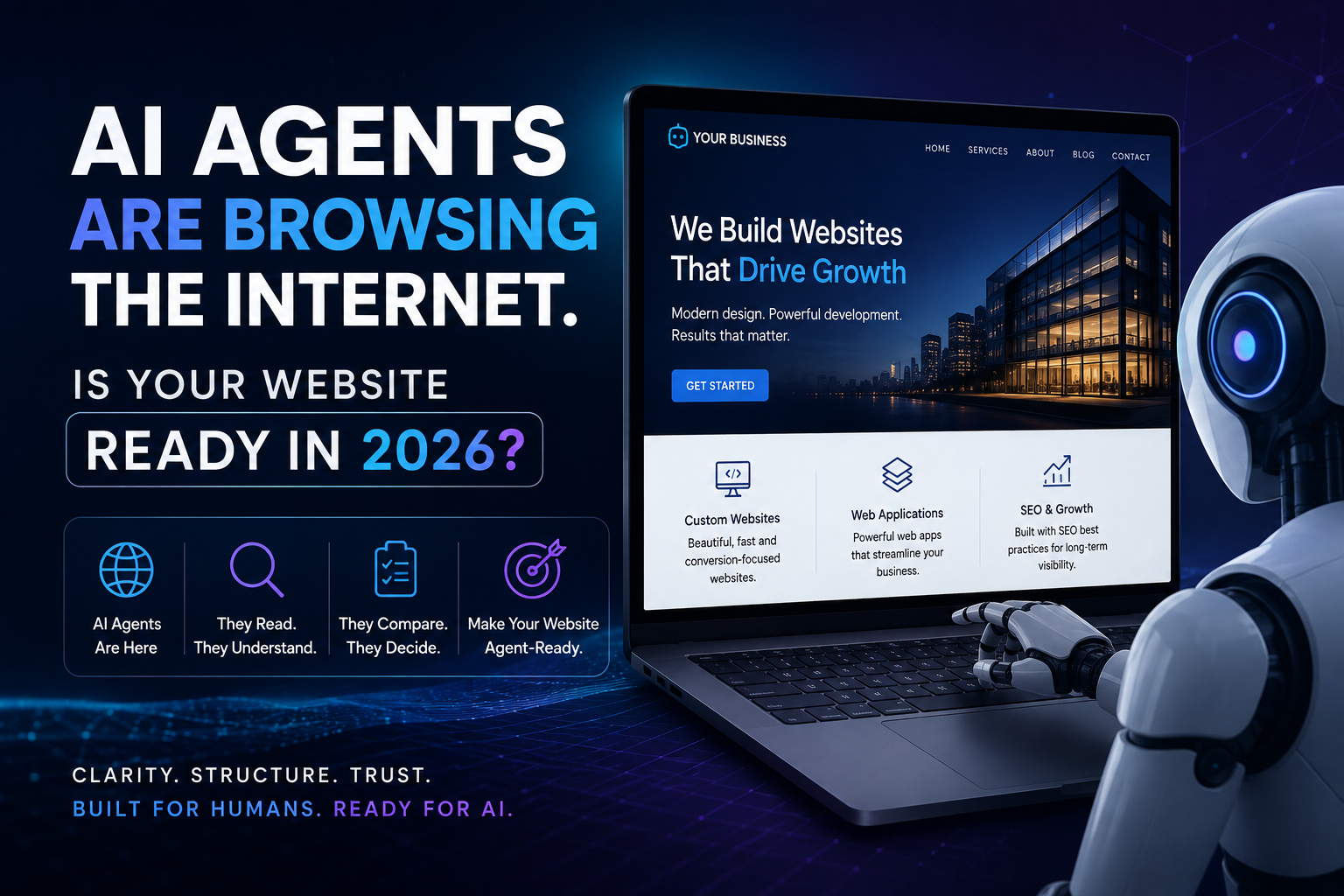
The next visitor to your website might not be a person.
That sounds futuristic, but the web is already moving in this direction.
For years, websites were designed primarily for human visitors. Someone searched for a product or service, opened a website, read the information, filled out a form or contacted the business.
AI agents are introducing another possibility.
Instead of a person manually searching through multiple pages, an AI agent can increasingly help find information, compare options, understand content and assist with tasks on behalf of a user.
This creates an important question for businesses:
Is your website ready for AI agents?
What Are AI Agents?
AI agents are software systems that can understand a user's goal, gather information and perform multiple steps to help accomplish a task.
Unlike a simple chatbot that only responds to a question, an AI agent can potentially work through a sequence of actions.
For example, imagine someone asks:
"Find me three web development companies that can build an e-commerce website, compare their services and help me decide which one fits my budget."
A traditional search experience might provide a list of websites.
An AI-powered agent can potentially research relevant information, compare options, interpret the available details and help the user move toward a decision.
The exact capabilities depend on the technology, permissions and websites involved, but the direction is clear: the web is becoming increasingly accessible through intelligent software.
AI Agents Are Becoming Another Type of Web User
Traditionally, businesses have thought about website visitors in one simple category:
Human visitors.
But websites are already accessed by many different kinds of software, including search crawlers, accessibility tools, APIs, automated systems and other services.
AI agents add another layer to this ecosystem.
An AI agent may need to understand:
What a business does.
What products or services it provides.
Who it serves.
How much something costs.
What options are available.
How to contact the business.
What information is trustworthy.
Whether an action can be completed online.
This means businesses should start thinking about websites not only as pages that look good to humans, but also as structured sources of information that modern software can understand.
How AI Agents Can Interact With Websites
The way an AI agent interacts with a website can vary significantly.
Depending on the technology, it may be able to discover pages, read content, extract relevant information, follow links, compare information or interact with certain website features.
Some systems may simply use websites as information sources.
More advanced agentic systems can potentially interact with web interfaces to complete specific tasks.
For example:
A customer wants to compare products.
An AI agent finds relevant product pages.
It reads specifications and pricing information.
It compares the available options.
The user receives a summary and decides what to do next.
In another situation, an agent may help a user find a service, understand the available options and navigate toward an enquiry or booking.
The important point is that the website becomes part of an automated decision-making workflow.
Why This Matters for Businesses
For businesses, this shift could change how online discovery works.
Today, companies often optimise their websites for:
Search engines.
Human visitors.
Mobile devices.
Conversions.
Accessibility.
Performance.
In the future, websites may increasingly need to work well within workflows involving AI systems and agents too.
Imagine someone asking an AI system:
"Find a company that builds custom CRM software for small businesses."
The AI system needs reliable information to determine which businesses are relevant.
If your website clearly explains what you do, who you help, what services you offer and why customers should trust you, your business is easier to understand.
If that information is hidden behind confusing navigation, images, unclear copy or inaccessible interfaces, it becomes harder for both humans and automated systems to interpret.
What Is an Agent-Ready Website?
An agent-ready website is not simply a website with an AI chatbot.
It is a website that makes its important information clear, structured, accessible and usable for modern software systems as well as human visitors.
An agent-ready website should make it easy to understand:
Who the business is.
What the business offers.
Who the service is for.
What products or services are available.
What the important features are.
How much things cost, where appropriate.
How customers can contact the business.
What actions are available.
What information can be trusted.
This does not mean redesigning every website around AI.
It means building websites with clarity and strong technical foundations.
1. Make Your Business Information Clear
Start with the basics.
Your homepage should quickly communicate:
Who are you?
What do you offer?
Who do you help?
What makes your business different?
How can someone contact you?
Avoid making visitors search through multiple pages to understand what your business actually does.
Clear information helps people make decisions and also gives automated systems better context.
2. Use Clear Website Structure
A well-structured website is easier to navigate and understand.
Organise your website logically.
For example:
Home
About
Services
Individual Service Pages
Case Studies
Blog
FAQs
Contact
Each page should have a clear purpose.
Your URLs, headings, navigation and internal links should help explain how different parts of your website relate to one another.
A clean information architecture benefits humans, search engines and other software that needs to interpret your website.
3. Write Content That Answers Real Questions
People do not always search using short keywords.
They ask complete questions.
AI systems are designed to handle this type of natural-language interaction.
Instead of only creating pages around keywords such as:
"web design"
"SEO services"
"CRM development"
create useful content around questions customers actually ask.
For example:
How much does a business website cost?
How long does a website take to build?
Do I need SEO for my new business?
What is the difference between a custom CRM and an off-the-shelf CRM?
How can a website generate more enquiries?
This type of content gives your website more useful context.
4. Make Important Information Machine-Readable
Good website design is not only about visual appearance.
The information behind the interface matters too.
Use clean HTML structure and appropriate semantic elements.
Use headings correctly.
Label forms clearly.
Make links descriptive.
Keep important information available as actual text rather than placing everything inside images.
Where appropriate, structured data can also help search systems understand entities such as businesses, products, services, articles and other types of information.
The goal is simple:
Make your information easy to interpret.
AI Agents Are Browsing the Internet: Is Your Website Ready in 2026?
5. Use Structured Data Where It Makes Sense
Structured data can provide additional context about the information on a webpage.
Depending on the type of website, this may include information about:
A business.
Products.
Services.
Articles.
Events.
FAQs.
Reviews.
Organisations.
Structured data should accurately represent the visible and relevant information on the page.
It is not a shortcut for ranking.
Instead, think of it as another way of communicating what your content means.
6. Keep Your Website Fast and Accessible
An agent-ready website still needs to be a good website.
Performance matters.
Accessibility matters.
Mobile usability matters.
Clear navigation matters.
A website that is slow, difficult to navigate or technically broken is not providing a good experience for anyone.
Focus on:
Fast loading pages.
Responsive design.
Accessible navigation.
Readable text.
Descriptive links.
Proper form labels.
Optimised images.
Clean code.
Secure connections.
Strong technical foundations.
These improvements help create a better overall web experience.
7. Make Your Services Easy to Understand
One common mistake businesses make is writing service pages that sound impressive but explain very little.
Instead of saying:
"We provide innovative digital transformation solutions."
Explain exactly what you do.
For example:
"We build custom CRM software that helps businesses manage customers, enquiries, sales and internal workflows from one system."
Specific information is more useful.
Your website should answer the questions a potential customer would normally ask before contacting you.
8. Don't Hide Important Information
If pricing information, service details, specifications or business policies are important to a customer's decision, make them reasonably easy to find.
Do not force users to click through ten pages just to understand what you offer.
The same principle applies to AI-driven discovery.
When important information is clearly available, it is easier for different systems to understand your business.
9. Build Strong Internal Linking
Your website should not be a collection of isolated pages.
Connect related content.
For example, a page about website development can link to:
Website conversion.
SEO.
AI search.
Case studies.
Relevant blog articles.
This helps visitors discover more information and gives search systems additional context about the relationship between your pages.
10. Create Genuine, Useful Content
AI has made it easier than ever to produce large amounts of content.
That does not mean every business should publish hundreds of generic articles.
In fact, generic content is becoming easier to ignore.
Create content that demonstrates:
Experience.
Expertise.
Original thinking.
Real examples.
Case studies.
Research.
Practical advice.
Unique insights.
If your business has actually solved a problem for a customer, explain how you solved it.
Real experience is much more valuable than another generic article repeating information that already exists everywhere.
AI Agents and SEO
AI agents do not mean SEO suddenly becomes irrelevant.
Search engines and AI systems still need to discover, understand and evaluate information.
Many traditional SEO fundamentals remain useful:
Crawlable pages.
Useful content.
Clear structure.
Internal links.
Fast websites.
Mobile usability.
Relevant authority.
Accurate information.
Strong user experience.
The difference is that businesses now need to think about visibility across a broader search and discovery ecosystem.
SEO is evolving alongside AI-powered search.
AI Agents and AEO
This also connects with Answer Engine Optimisation, or AEO.
AEO focuses on making content useful for systems that provide direct answers to user questions.
For example, instead of only trying to rank for:
"best website development company"
you can create useful content that answers:
"What should I look for when choosing a website development company?"
"What does a custom website include?"
"How much does a professional website cost?"
"When should a business build a custom website?"
The more clearly you answer genuine questions, the more useful your content becomes across modern discovery experiences.
AI-Readable vs AI-Actionable Websites
There is an important distinction here.
An AI-readable website provides information that an AI system can understand.
An AI-actionable website goes a step further by making useful actions possible.
For example:
Reading product information is one thing.
Being able to check availability is another.
Reading about a service is one thing.
Being able to submit a structured enquiry is another.
Reading about a booking is one thing.
Being able to initiate a booking process is another.
The future of agentic websites could involve more interaction between AI systems and business functionality.
APIs, structured data, clear forms and well-designed workflows can become increasingly important in these scenarios.
Your Website May Become Part of an AI Decision
Consider a simple example.
A person asks an AI assistant:
"I need a website for my business. Find companies that build custom websites and compare their services."
The AI needs information.
It may look for businesses that clearly describe their services.
It may evaluate available information.
It may compare different options.
It may present recommendations to the user.
The customer might never begin their journey by searching for your company name.
They may discover your business because an AI system found your website relevant to their question.
That changes the concept of online visibility.
Your website is no longer only trying to attract visitors directly.
It also needs to communicate your value clearly enough to participate in the broader discovery ecosystem.
What Businesses Should Do Now
You do not need to rebuild your entire website tomorrow.
Start with the fundamentals.
Review your homepage.
Is your business immediately understandable?
Review your service pages.
Are your services clearly explained?
Review your content.
Does it answer real customer questions?
Review your navigation.
Can users easily find important information?
Review your technical foundation.
Is the website fast, responsive and accessible?
Review your structured data.
Are you using appropriate markup where it genuinely helps describe your content?
Review your conversion paths.
Can a customer easily contact you, request a quote, book a service or take the next step?
These improvements are valuable whether the visitor is a human, a search engine or an AI-powered system.
The Future of Websites Is More Than Visual Design
A beautiful website is important.
But visual design is only one part of a successful digital presence.
The next generation of websites will need to combine:
Design.
Performance.
Accessibility.
Structured information.
Useful content.
Search visibility.
Security.
Business functionality.
Automation.
AI compatibility.
The best websites will not simply look good.
They will communicate clearly and work effectively within a much larger digital ecosystem.
Final Thoughts
AI agents are changing the way people can interact with the internet.
The web is gradually moving from a model where people manually search, read and click through websites toward experiences where intelligent systems can help discover information, compare options and complete parts of a user's workflow.
This does not mean websites are becoming obsolete.
It means websites are becoming more important as reliable sources of business information and digital functionality.
Businesses that build clear, fast, accessible and well-structured websites will be better prepared for this change.
You do not need to build a website exclusively for AI.
Build a website that works exceptionally well for humans and is structured clearly enough for modern technologies to understand.
Because in 2026, your next important website visitor may not have a face, a keyboard or even a browser tab open.
It may be an AI agent working on behalf of your customer.
Want Help With This?
Let's talk about how this applies to your business.